Shared Workstations
Image courtesy of Stantec
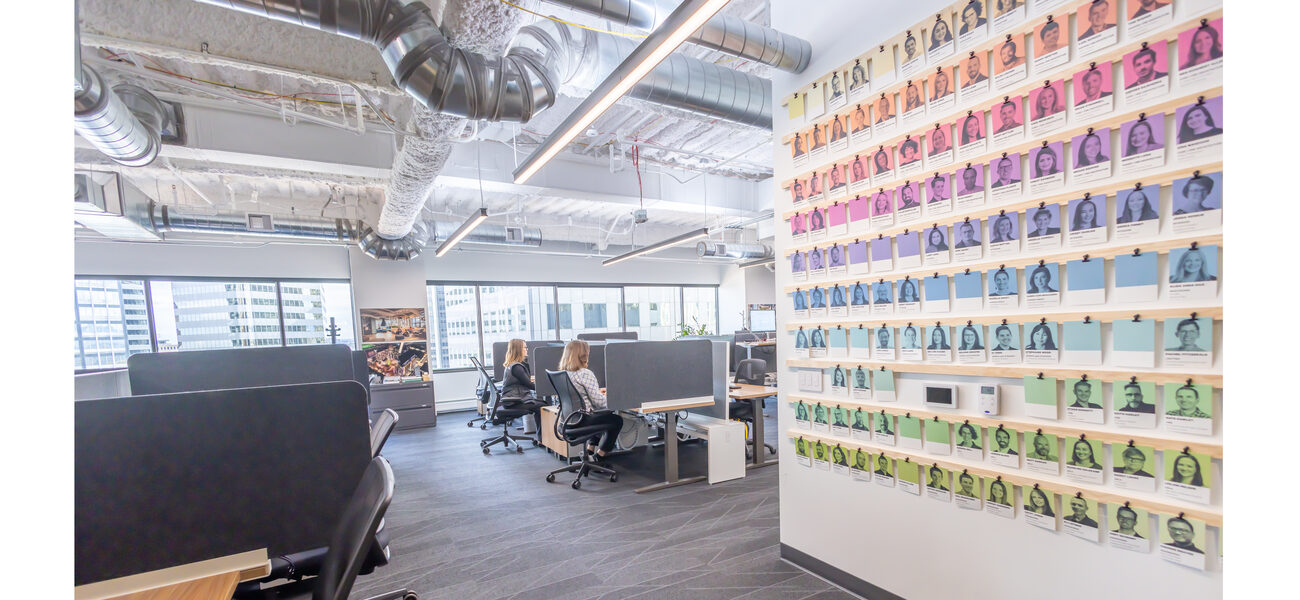
Workspace within Stantec’s Denver office includes shared workstations and a wall referred to as the “pantone wall” featuring pictures of all team members, grouped on the wall by colors assigned to each design studio/team.
Before Workplace Strategy
Image courtesy of Stantec
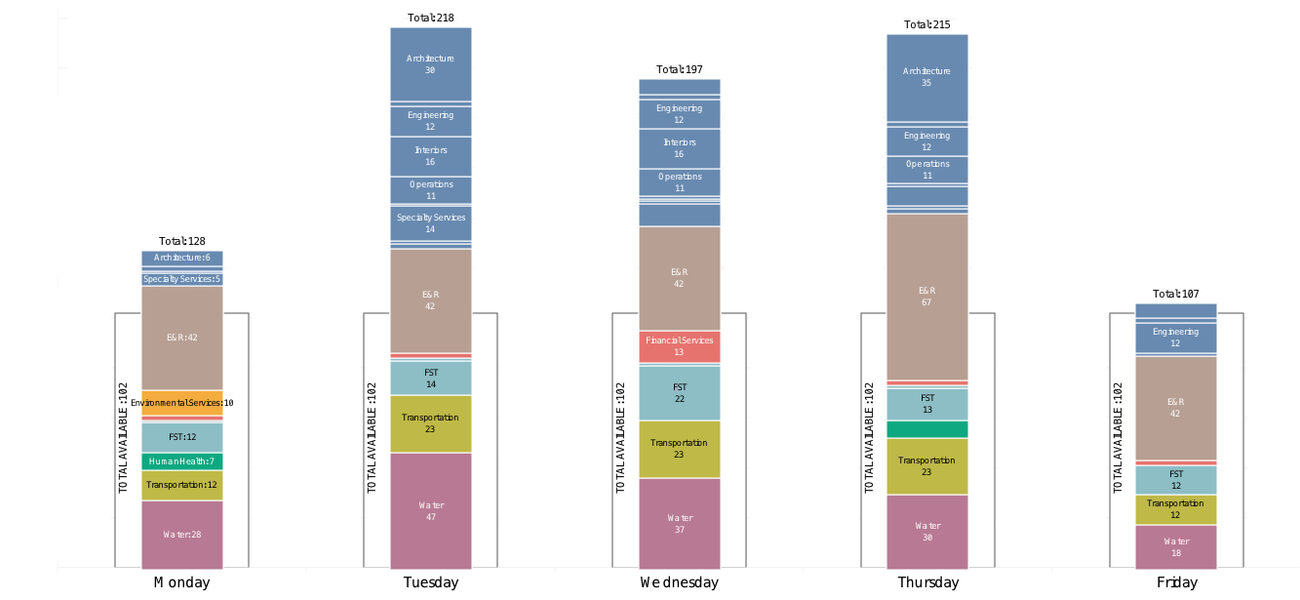
A comparison of daily seat availability versus team-specific seat demand highlights gaps that informed future planning.
During Workplace Strategy
Image courtesy of Stantec
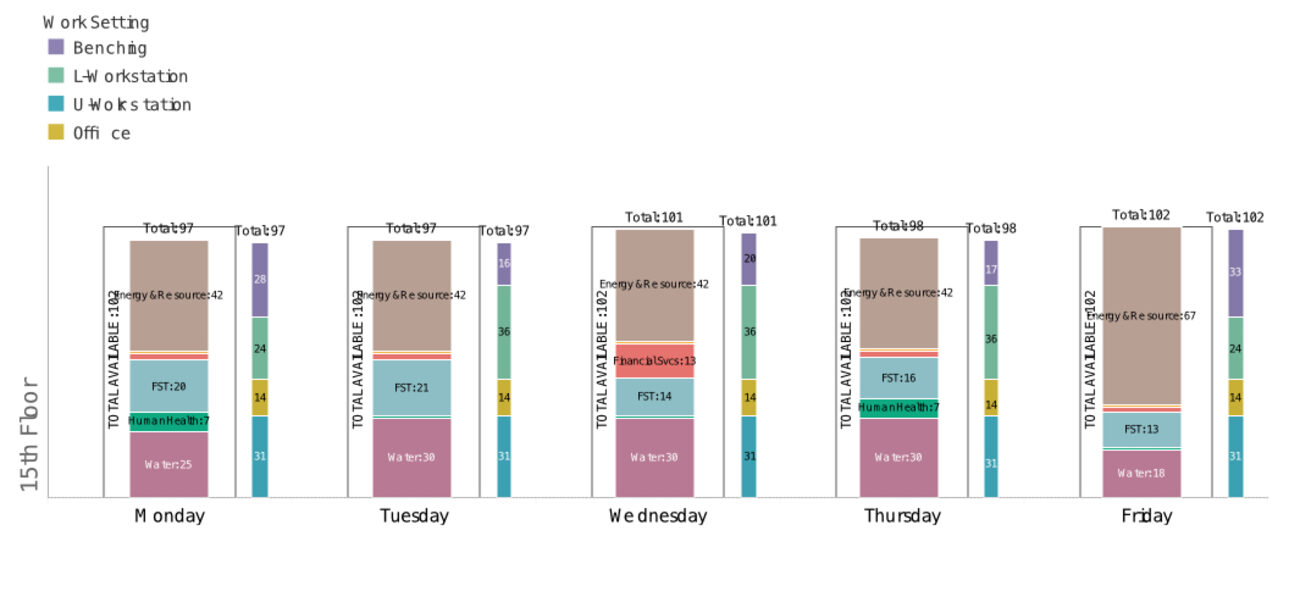
Expanded seat availability with an additional floor by day and team reflects scenarios developed to meet evolving space needs.
Hybrid workplace strategies continue to make headlines, as some high-profile companies are requiring all employees to return to the office five days a week. Many other companies, such as Stantec, a global architectural engineering firm, continue to embrace the hybrid approach, giving employees the flexibility to work remotely part of the week while fostering in-person collaboration during designated office days. Stantec initially adopted this hybrid approach due to pandemic restrictions, but, after seeing the collaborative and financial benefits, decided to maintain their commitment to supporting hybrid work environments.
“Leases on all three of our facilities in the Denver area came due during Covid, which led us to question whether we really needed the same amount of office space in the future,” said Jason Behrens Whitlock, practice leader and principal of Stantec’s building group in Denver. “At that time, we were unsure when workplace restrictions would be lifted so we decided to reduce from three leased spaces to using just one floor with 77 available desks that could be booked by our 500 Denver-area team members using hoteling practices.”
Whitlock explains that this initial approach allowed employees to pick and choose which days they would be in the office and grab whatever desks were available. “We realized very quickly that this type of open hoteling strategy was not working well,” says Whitlock.
Employee surveys conducted during this time showed that many employees wanted to feel more connected as a team. “We knew that we needed to correct these impressions, but we weren’t ready to give up on the hybrid approach,” says Whitlock. “The technology upgrades that we’ve made for remote work have led to facility cost savings and efficiencies, including smoother meetings at client sites and easier connections during travel. However, we also see the benefits of in-person collaboration, especially the value it brings to mentoring new staff and retaining talent.”
Turning to Their Own In-House Expert to Reevaluate
“Our leadership team realized that before we made our initial attempt at hybrid scheduling, we should have consulted with our own in-house experts who often analyze similar situations and provide solutions for our clients,” says Whitlock. “So, we asked Stephanie Moser Wood, Stantec’s workplace strategist lead for the U.S. in Denver, to treat us as a client and suggest a better plan.”
“Doing this analysis for our own team really drove home how deeply personal this process is,” says Wood. “It’s not just deciding how many desks to have, but understanding who the people are working at those desks and learning how they prefer to work.”
Wood noted that since she was already familiar with Stantec’s mission, structure, and design teams (also known as design studios), this streamlined the initial discovery phase typically used to learn about a company’s objectives. Wood and her team then collected a variety of data to help determine how many seats were needed and whether an additional floor should be added. Wood explained the importance of collecting data from a variety of sources, rather than relying on just one type of data to drive decisions.
For this project, key data reviewed included:
- Utilization Studies that analyzed the number of available seats compared to how requests for those seats varied on each day of the week, and actual usage.
- Employee Surveys and focus groups that questioned employees about workstyle preferences, including workstation set-up and scheduling requests.
- Interviews to engage with team leads to uncover additional team-specific workflow and collaboration needs.
“Based on the data collected, it was very clear that we needed to add a second floor to accommodate the number of people who wanted to work on site each week, and we needed to provide better direction on how and when that space could best be used and shared,” says Whitlock.
The Finalized Guideline
“When our leadership team approved what we now refer to as the ‘finalized guideline,’ we made it clear that this truly is a guideline and not a mandate,” says Whitlock. “We value flexibility and encourage all employees to consult with their supervisors to find a schedule that works best for their individual and team work styles.”
Stantec’s finalized guideline for its Denver office, which was first introduced in the spring of 2024, says that:
- 50% of an employee’s hours should be spent in the office.
- Two days each week, employees will have a reserved space within their design studio’s neighborhood.
- A third day of attendance every other week is encouraged to help achieve 50% in-office presence. This day is not assigned and is at each employee’s discretion.
“Since the guideline was introduced, it has remained true to its initial principal of encouraging team members to come into the office at least 2.5 days a week,” says Wood. “Our neighborhoods, which are groups of workstations assigned to each design studio, have fluctuated a bit over time since we are currently seeing an increased desire to come into the office.”
Rather than an open hoteling approach, Stantec used a scheduling tool that helps assign specific workstations in advance each week. There is a mix of approaches used:
- Scheduled – The number of assigned days for each team and team leaders determine seating within the neighborhood made up of shared workstations. On scheduled days, seats are automatically reserved.
- Core Days – Each team has an assigned core day or days, and then employees book their desk for an additional eight hours during the week for a time that works best for them.
- Flex Hours – Employees are responsible for booking their desk during flex times of their choice. This can be used for quiet focus work or for collaborative work.
In addition to the individual workstations, there are larger rooms available to book for team meetings. Stantec leadership plans to evaluate the guideline annually to ensure that the amount of in-house office space available aligns with how team members prefer to work.
Encouraging Employee Engagement
To build consensus for the process used to create the new hybrid work guidelines, Stantec selected several team members to serve as “change ambassadors”—liaisons between leadership and staff—to communicate proposed changes and share employee feedback. This two-way conversation allows for efficiency and transparency.
“Companies that invest in employee engagement tend to perform better in all ways,” says Wood. She points to studies that consistently show a correlation between employee engagement and higher financial outcomes in terms of both profits and stock performance. Greater employee engagement has also been linked to lower turnover rates, improved production, and increased customer loyalty.
Stantec introduced these new guidelines by hosting a “spirit week” that included fun activities such as a chili cook-off and a golf event. Since the introduction, the company continues to host events such as lunch-and-learns to encourage camaraderie and employee engagement.
“The key is personalizing your schedule to reflect your company’s unique combination of space, culture, cost, and utilization needs,” says Wood.
By Amy Cammell