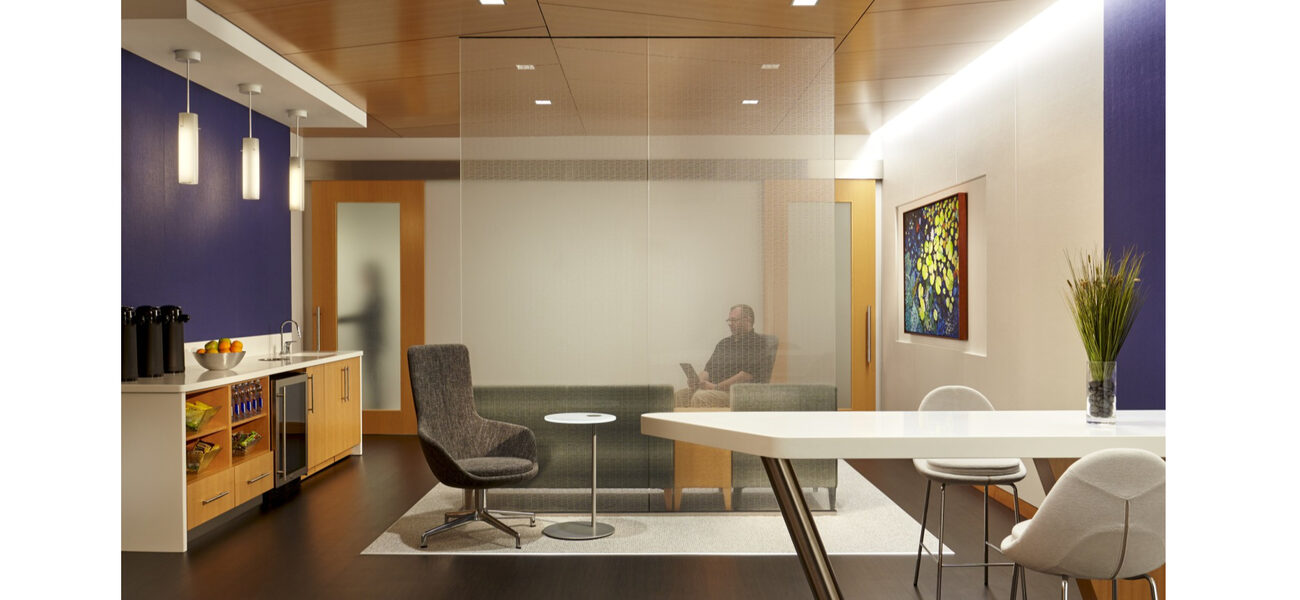
Privacy with Visibility
Photo courtesy of CannonDesign
Frosted glass in a staff area in a surgery center at M Health at the University of Minnesota helps create privacy without losing visibility. A variety of seating options gives staff members choices about where to consume the all-important coffee.
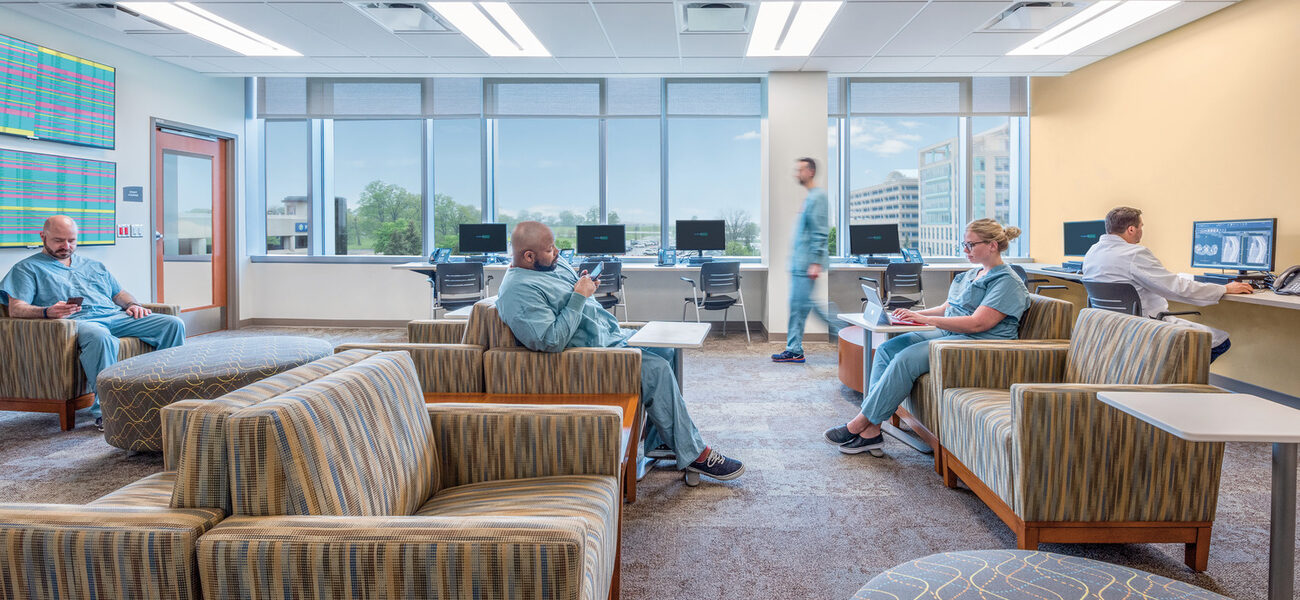
Natural Light amd Seating Options
Rendering courtesy of CannonDesign
A staff area at the Froedtert Surgery Center at the Medical College of Wisconsin offers natural light and a range of comfortable options for medical team members on breaks.
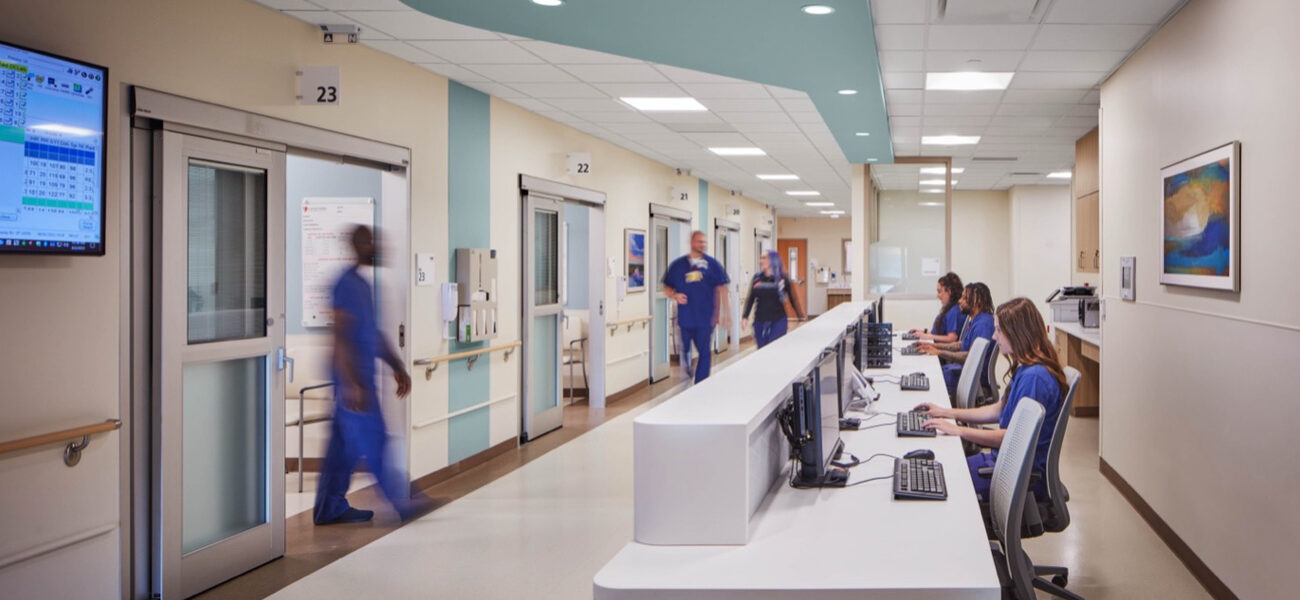
Nurses' Station
Image courtesy of HKS
A nurses’ station offers visual links to patient rooms and connecting spaces, with a semi-private space for mini-meetings and focused work.
It’s no secret that many healthcare organizations are struggling to attract and keep enough staff to look after their patients. New space plans are offering solutions to the staffing challenge that increase healthcare worker satisfaction and success by making it easier for them to do their job. Not all staffing considerations are building-related, but there are many ways the building can work to help doctors, nurses, therapists, and aides do their jobs more effectively while maintaining their own physical and mental health. That balance is attractive to healthcare workers.
“When we talk now about the programming of space, we have a lot of clients who want to talk about investing in the wellbeing of their staff,” says Natalie Petzoldt, a principal and Healthcare Practice leader at CannonDesign.
“The facility design impacts staff wellbeing,” says Louis Meilink, senior principal at Ballinger.
They and others who plan healthcare facilities say organizations are less likely to invest in major amenities such as gyms and daycare centers. Instead, they provide those benefits by partnering with places in the community that already specialize in the services. “We were looking at a prototype for a building that has healthcare, research, and maker space, along with daycare and fitness and food,” says Meilink. “But is that a cost model that can be afforded? We don’t know. It’s utopian if you could put it all in one building.”
‘Fix the Work’
Deborah Wingler and Michelle Ossman are deeply involved in planning healthcare space to facilitate the work that will take place there. Wingler is a principal and global practice director for Applied Research at HKS; and Ossman, a former critical care nurse practitioner, is an architect and director of research at MillerKnoll. They have conducted and authored a major study on the role of architecture and space planning in preventing burnout in nurses.
Wingler says that attractive break rooms and private spaces are great, but many nurses don’t even have time to take their breaks. She says that another common approach—encouraging better self-care among nurses—just puts the burden of preventing burnout back on the very people who are suffering from it. So what will have a positive effect?
“Let’s fix the work,” says Ossman. “Make it less burdensome; make it easier to do our jobs. In addition to all the typical office workplace demands, nursing work is also highly physical.”
Facility planners and researchers agree that many medical professionals at all levels are motivated to stay in jobs where they can do good work and make a difference for their patients. “Caregivers want to give good care,” says Meilink. “When they’re in an environment where they feel safe and comfortable, they’re going to give more empathetic care.”
So how to create a building that facilitates patient care? Start by tracking what the nurses and aides must do in the course of their shifts, say Wingler and Ossman. Are they taking extra steps because the dirty sheets go in one place and the clean sheets are at the other end of the hall? How can you situate their frequently used support spaces closer so they can spend more time with patients and less time transporting things?
Meilink at Ballinger suggests observing and planning for peak occupancy and shift changes, when the largest number of people require work spaces. Is there enough room for them to meet? Is there a place where they can talk privately about patients’ conditions and other information that shouldn’t be discussed in a hallway?
Collaboration Spaces
Rebecca Casey, principal and architect with SMRT Architects & Engineers, says there is demand for collaboration spaces, with some facilities opting for a “bullpen” model with exam rooms surrounding a shared staff area.
While the need remains for small private consultation and telemedicine spaces, clinical professionals often no longer have private offices, or have smaller ones. Instead, a professional might have a choice of “touchdown” spaces in which to work—a small office, a space in a shared workroom, or a focus room for work that demands quiet and privacy.
“One of the keys is reducing the number of dedicated spaces,” such as private offices, says Meilink.
“We design spaces for collaboration, but the care model and operational training need to reinforce it for it to be successful,” he adds. Organizations that opt for these kinds of layouts—which do save more space for patient-focused operations—should consider the management work for culture change that is needed to cultivate the best use of these kinds of spaces, and the time and resources needed to support that use.
Petzoldt of CannonDesign notes that collaboration often involves breaking down barriers among staff. For instance, surgeons shouldn’t have a separate lounge from the rest of the staff. At one institution, she notes, staff were encouraged to refer to themselves as a “member of the care team” no matter what initials were after their name. Efforts to change spaces without changing culture are not often successful. “We give a lot of thought to how much impact we can realistically have on cultural change,” she says.
Furniture and Flexibility
Space planners are focusing on ways to maximize the flexibility of healthcare facilities to accommodate whatever kind of work may occur there in the future. This is seen in projects ranging from renovations to strategic overhauls of entire campuses. “You can never really account for how the patient and the family are going to need to be in the room,” says Wingler. One solution is furniture on wheels that can easily be reconfigured in spaces designed to accommodate change. Wingler likes modular systems like Herman Miller’s Co/Struc, that organize supplies in drawers that can just be fitted into existing furniture.
Many organizations are realizing that nurses benefit when they have the authority to organize their work in the ways that work best for them. That authority is a powerful recruiting and retention benefit. As Wingler points out, “Nurses tend to be very individualistic in terms of how they deliver care. This is personalization so they can deliver their best care.”
Meilink goes a step further and recommends designing rooms that can provide future flexibility —for example, an exam room that could also be used as a consultation space, training room, or office.
Space Planning for Staff Safety
Casey, at SMRT, says safety is also a key factor in whether people want to stay in their jobs. “We worry about violence, but really most injuries are fists and feet and so on,” she says, recommending that staff position in care rooms have easy access to exits. With the increase in demand for behavioral health services and facilities, she wants healthcare teams to consider risk assessments and physical space plans for protective back-up in their buildings. Check-in and check-out spaces need privacy, but also can’t be too enclosed—some staff members have to work in these spaces all day and need to feel safe but still connected and accessible to patients and families.
Wingler and Ossman also want healthcare organizations to consider cleanability when choosing finishes and furniture, not just when the items are new, but 10 and 20 years down the line. “Be aware of what you’re putting into your spaces and what is required to maintain it,” says Wingler. “It has implications to your maintenance team, your sustainability goals, and the wellbeing of nursing staff.”
Environmental Space Factors for Personnel
There’s no denying the stresses of healthcare work, and one of the ways to help with stress is to give employees access to nature. Casey is a proponent of the WELL certification program, which encourages evidence-based features to promote human health and wellbeing. While few healthcare organizations are ready to sign on to the program, its standards are a good place to start in designing healthcare spaces.
Sound is one often-overlooked factor. But dampening all sound isn’t always the solution. As a nurse, “There are some sounds that you need to be able to hear—which room is the coughing fit coming from?” says Ossman.
And of course, there’s competition for natural light. “We make a point to locate staff lounges along a window,” says Meilink. “If you take a break for 10 minutes, you should see daylight.” Patient rooms and work areas also benefit from windows.
When a window isn’t an option, “there are so many more options now for circadian-rhythm-supportive lighting,” says Casey. For staff rest areas, she encourages softer lighting that gives people using the space a range of options. While skylights are expensive, Sky Factory is among the companies making virtual skylights that help brighten interior spaces.
Healthcare Runs on Coffee
Pedzoldt reports on a hospital that surveyed their staff to find out what amenities they wanted most. Daycare? Laundry? Grocery delivery? Package receiving? No, says Petzoldt. “For them, one of the biggest things was access to a coffee shop that serves Starbucks.”
By Patricia Washburn