College of Pharmacy
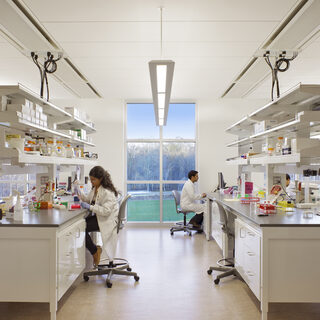
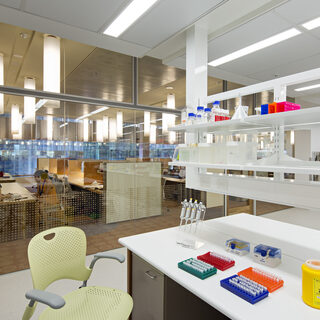
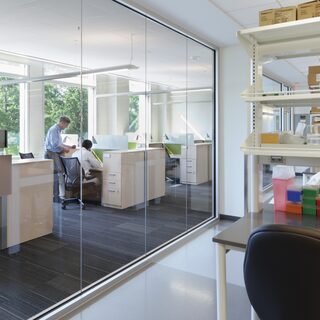
The new College of Pharmacy building at the University of Rhode Island allows the College’s scattered facilities to be housed under one roof for the first time.
Non-residential construction volumes and pricing continued their upward trend in the second quarter, with prices increasing an average of 2 to 4 percent in the first half of 2013. These factors, along with growing market confidence and a narrowing labor supply, will continue to push new construction costs closer to the trend line for the near to medium term.
Translational Research Institute (TRI) is a joint venture between The University of Queensland Diamantina Institute, Queensland University of Technology’s Institute of Health and Biomedical Innovation, Mater Research, and the Princess Alexandra Hospital Centres for Health Research.
Nanoviricides began construction in August of 2013 on a clinical scale cGMP production plant in Shelton, Conn. Designed by Id3A, the project includes renovation of an existing 18,000-sf facility to provide research labs, offices, and a cGMP pharmaceutical manufacturing suite with cleanrooms for the production of active pharmaceutical ingredients (APIs). The project manager and engineering consultant for the renovation is MPH Engineering. Completion is expected in early 2014.
The University of Minnesota will break ground in fall of 2013 on a $63 million microbiology research facility in Minneapolis. The 80,000-sf project will be the final building to be constructed in UM's $292 million Biomedical Discovery District and will house the Department of Microbiology and other departments and schools within the Academic Health Center. Designed by BWBR Architects, the facility will provide labs, offices, collaboration areas, pharmaceutical R&D suites, and biocontainment space for the study of infectious diseases.
The Vaccine and Gene Therapy Institute of Florida (VGTI), an offshoot of the VGTI at Oregon Health and Science University, is dedicated to developing vaccines and immunotherapies to combat diseases such as AIDS, cancer, tuberculosis, and diseases associated with emerging viral infections such as Dengue fever and pandemic influenza. The three-story, 101,000-sf facility contains 11,000 nsf of vivarium/containment space with integrated procedure and in-vivo imaging spaces, nine bioscience research lab groups, specialty support labs, offices, and conference space.
Pfizer is investing $130 million to expand its pharmaceutical manufacturing operations in Ireland. Pfizer's Grange Castle campus in Clondalkin will undergo a $100 million renovation and expansion to double current production of therapies for rheumatoid arthritis. Completion is expected in 2015. A $23 million upgrade of the Ringaskiddy campus will support the manufacture of new cancer treatments and other medicines.
The recently opened Translational Research Institute (TRI) in Brisbane, Australia, combines four major research institutes into a single medical and biopharmaceutical research facility where new treatments can be developed, manufactured, and clinically tested in one location, greatly shortening the time between discovery and application.
The University of Nebraska broke ground on the $35 million College of Pharmacy and Center for Drug Discovery in June of 2013. Located at the University of Nebraska Medical Center in Omaha, the 85,000-sf teaching and research building will provide classrooms, faculty offices, 15 drug discovery labs, a sterile compounding suite, and a model pharmacy for simulation training. The design team includes The Clark Enersen Partners and RDG Planning & Design.
Dainippon Sumitomo Pharma will open the $65 million Chemistry Research Building in Osaka in July of 2013. Located at the Osaka Research Center, the 175,690-sf facility houses laboratories for drug discovery, process chemistry, and analytical research and development. Construction began on the project in January of 2012 and reached completion in June of 2013.
Continued signs of stable economic growth indicate that the recovery is gaining momentum in many parts of the United States and Canada. Construction selling prices for institutional projects grew at a 6 percent annualized rate in 2012, on top of a 3 percent increase in 2011. Construction costs are expected to continue stabilizing and rising in many regions as market confidence and capital spending increase.
The six-story Academic Health Sciences Centre embraces multidisciplinary, highly technical research, while supporting Saskatchewan's commitment to provide exceptional healthcare for the people of the province. Flad Architects collaborated with Henry Downing Howlett Architects to design the new D Wing, which houses research labs, animal facilities, and academic offices for biomedical and pharmaceutical researchers from the various Health Sciences Colleges and units at the University of Saskatchewan.
PrimeCell is building the $50 million 4MEDia center in Ostrava in the Czech Republic. Located on the campus of Ostrava Teaching Hospital, the 70,000-sf biomedical research facility will accommodate 150 investigators creating therapies for conditions including heart disease, dementia, multiple sclerosis, and diabetes. The project will foster collaboration with academic research institutions and industry partners for the commercial development of pharmaceutical products. Completion is expected in mid-2014.
The Performance Guaranteed Facility (PGF) model is a relatively new type of public/private partnership that allows the occupants to own a building the moment construction begins, while private-sector partners commit to its design, construction, financing, and ongoing maintenance, including future rehabilitation. The model goes by different names, but the concept involves an interactive partnership designed to benefit all parties for the long term.
Pfizer has located its corporate headquarters for the Center for Therapeutic Innovation group on the top floor of the Center for Life Science | Boston (CLSB) building, in the heart of the Longwood Medical Area.