Vermeulens Releases Q2-2021 Market Outlook
Vermeulens has released its market outlook report for the second quarter of 2021. Key points include:
Faculty in higher education often spend less than 20 percent of their workday at their assigned desks, so why do they still have them? It is a question that academic administrators are asking, as they look for ways to provide building occupants with the spaces they need to do their work and the autonomy to select the right space for the right task, all within an increasingly constrained campus footprint. Corporate offices have been making the transition to unassigned seating for years now, and despite trepidation, there are signs that academia may be following suit: In a recent survey of 88 U.S. colleges and universities (conducted by the Society for College and University Planning and brightspot, a Buro Happold company), about 62 percent of respondents said they are pursuing more flexible or unassigned workspaces for administrative staff, and 54 percent are planning to do so for academic work facilities, as well.
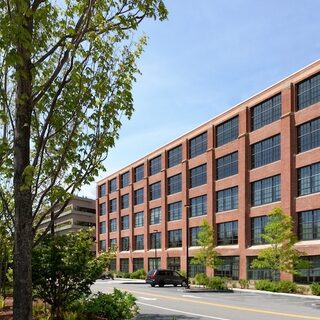
Landmark Bio began construction in July of 2021 on a leased facility in Watertown, Mass. Supported by $76 million in funding, the 40,000-sf project will accelerate the availability of novel therapeutics by collocating research, development, manufacturing, and commercialization activities in the same structure. Featuring eight GMP cleanrooms configured to allow production of both cell and viral vector materials, the center will include labs, offices, and quality control suites.
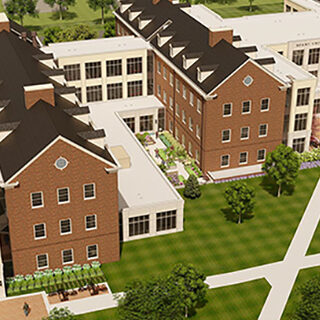
Miami University is constructing a $96 million health sciences building in Oxford, Ohio. Designed by BSA Lifestructures, the 165,000-gsf facility will create dynamic synergies between programs in nursing and allied health professions. The north wing of the three-story structure will offer classrooms, teaching labs, a fitness studio, and a wellness center. The middle wing will house research labs, faculty and staff offices, interprofessional lounges, eight simulation suites, a wet/dry training lab, two 20-bed skills labs, and a gross anatomy lab.
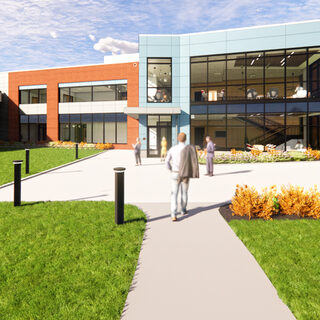
Lord Fairfax Community College is constructing the $30 million Hazel Hall in Warrenton, Va. Designed by Grimm + Parker, the 40,000-sf facility will provide multifunctional learning environments for programs in science, engineering, and health professions. The two-story structure will include a nursing skills lab, simulation suites, science labs, engineering and fabrication labs, classrooms, study areas, faculty offices, and a flexible 275-seat conference venue. Existing classrooms and labs in Wolk Hall will also be renovated.
Rutgers Cancer Institute of New Jersey and RWJBarnabas Health broke ground in June of 2021 on the $750 million Jack & Sheryl Morris Cancer Center in New Brunswick. Designed by HOK, the 510,000-sf structure will enable the consolidation of key cancer services in a single integrated location.
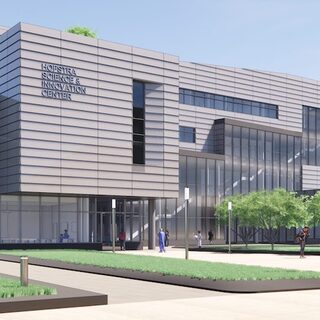
Hofstra University broke ground in June of 2021 on the $75 million Science and Innovation Center in Hempstead, N.Y. Designed by HLW, the 75,000-sf facility will feature technology-rich labs and classrooms for the DeMatteis School of Engineering and Applied Science. The project will also provide the Hofstra Northwell School of Nursing and Physician Assistant Studies with advanced learning environments for interprofessional education including state-of-the-art simulation suites and clinical teaching labs.
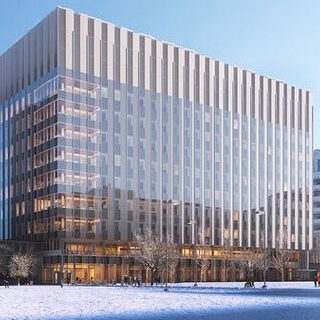
Winstanley Enterprises broke ground in June of 2021 on a $100 million bioscience research center in New Haven, Conn. Designed by Elkus Manfredi Architects, the 10-story, 525,000-sf facility will provide leasable laboratory and office environments for biomedical companies and academic institutions. Featuring a large public plaza, the collaborative structure will include a 48,000-sf business incubator operated by BioLabs, a conference center, and a STEM classroom for K-12 education programs.
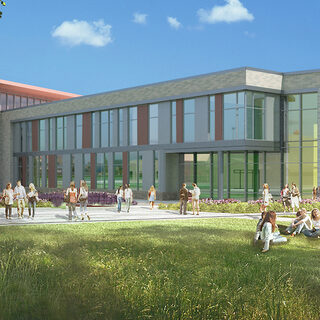
Stetson University broke ground in June of 2021 on the Cici & Hyatt Brown Hall for Health & Innovation in DeLand, Fla. Designed by Kahler Slater in association with Harvard Jolly Architecture, the 40,000-sf facility will offer flexible and transparent classrooms for active learning, teaching labs for health and environmental sciences, a GIS computer lab, and a Stress Management and Resiliency Training (SMART) lab.
The University of British Columbia is planning to construct the CAD$180 million Gateway Building on the Point Grey campus in Vancouver. Designed by Perkins&Will and Schmidt Hammer Lassen, the 269,000-sf project will offer sophisticated facilities for interprofessional education and research including wet and dry laboratories, high-fidelity simulation suites, flexible classrooms, and four large lecture halls.
Vermeulens has released its market outlook report for the first quarter of 2021. Key points include:
The University of Texas at Arlington is constructing a $76 million health sciences facility for the School of Social Work. Featuring flexible, technology-enabled learning environments, the 150,000-sf building will include teaching and research labs, study areas, and offices for faculty and staff. Designed by SmithGroup to enable an innovative pedagogy that enhances collaboration between allied health disciplines, the structure will also house the Smart Hospital, a clinical simulation center for the College of Nursing and Health Innovations.
Creighton University is planning to break ground in summer of 2021 on the $75 million CL Werner Center for Health Sciences Education in Omaha. Providing a new home for the School of Medicine, the five-story, 130,000-sf facility will enable students enrolled in allied health programs including nursing, pharmacy, physical therapy, occupational therapy, physician assistance, and behavioral health to learn and train with medical students in the delivery team-based care.
The University of British Columbia is planning to construct the CAD$136 million School of Biomedical Engineering Building on the Point Grey campus in Vancouver. The 151,305-gsf facility will accommodate teaching and research labs, collaboration spaces, meeting rooms, and offices. Featuring innovative learning venues for undergraduate and graduate programs, the building will provide classrooms, a 250-seat lecture hall, and a central atrium for informal learning and interaction.
Stanford University dedicated the $210 million Biomedical Innovation Building in November of 2020 in Palo Alto, Calif. Designed by ZGF Architects with Research Facilities Design (RFD) as laboratory design consultant, the 190,439-gsf facility strategically collocates investigators with expertise in cardiovascular medicine, pediatrics, orthopaedics, immunotherapy, personalized genomics, otolaryngology, and asthma and allergy.