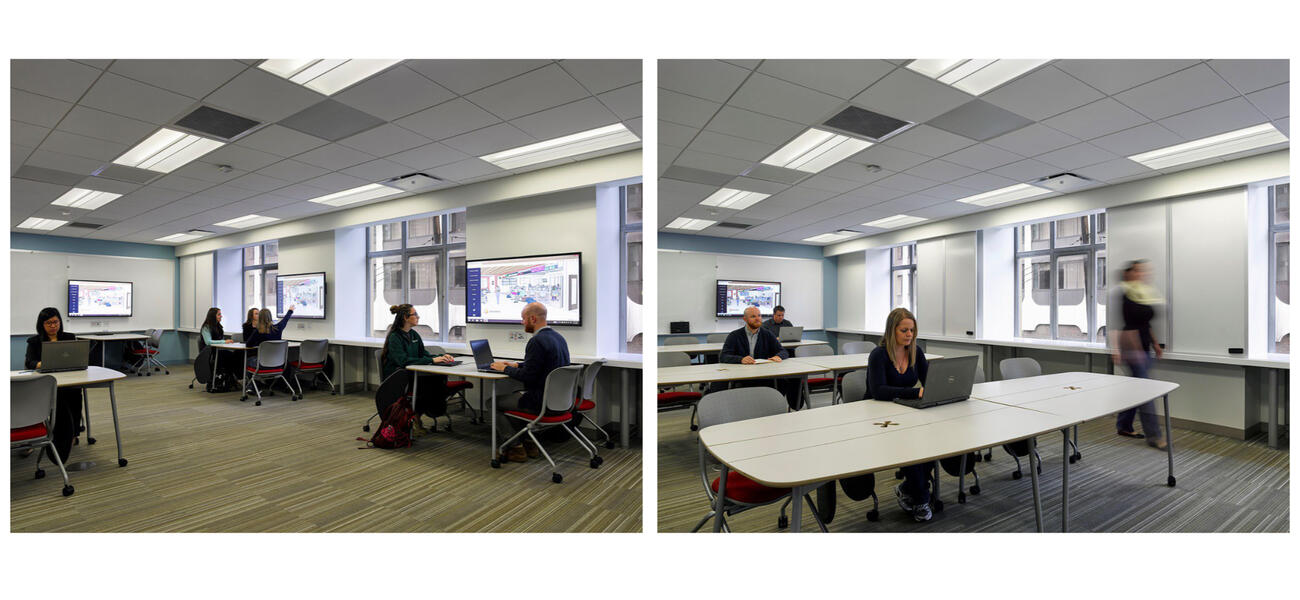
HyFlex Spaces
Courtesy of Stantec
Post-COVID, most universities have embraced the paradigm shift to include more online offerings and HyFlex teaching environments that support both online learning and traditional in-person options. HyFlex learning areas are ideally 10% larger than traditional classrooms to accommodate flexible modular furniture and more technology options.
An overall trend toward lower admission rates, paired with a rise in online learning, is leading many universities to question whether they are carrying excess classroom and research space. Undergraduate enrollment at U.S. universities fell by almost 15% between 2012 and 2022, and studies suggest that this number could continue to drop each year by as much as 100,000, perhaps more if international students do not return to U.S.-based programs. A study published by Inside Higher Education states that “if the U.S. lost 15% of its international student population, a substantial number of colleges could experience financial repercussions.” The actual number is higher. Using 2022 enrollment statistics, Vermeulens, a construction economist firm, estimates that as much as 38 million sf of existing higher ed academic classroom and lab space could be unnecessary or would be better off repurposed.
“Rightsizing campus facilities will also result in significant energy savings and embodied carbon reductions, helping schools reach federally mandated emissions reduction and decarbonization goals,” says James Vermeulen, managing partner.
“As an industry, universities and colleges need to be asking whether any new on-campus construction is justified or whether existing classroom and research space should instead be eliminated or repurposed,” says Alex Wing, principal and campus analytic specialist at Stantec in Pittsburgh.
“Most academic institutions realize that a good portion of coursework, especially lower level required courses, can be delivered online,” says Wing, citing statistics that showing a 14% increase in distance learning between 2012-2022 and that an estimated 25% of students planned to take at least one online course in 2022.
The analysis calculated the excess or unnecessary square footage within universities using a typical 12-hour undergraduate week. The calculation to determine area equals weekly student contact hours (WSCH) divided by available hours then multiplied by the area per seat. Based on a 10% drop in enrollment alone, the figures show a possible excess of more than 20 million sf. Factoring in the 14% increase in distance learning, the calculations show that more than 38 million sf of academic space could be repurposed.
“Many schools are embracing the online paradigm shift by converting traditional classrooms into HyFlex spaces that can easily flip from in-person use to networked or online collaboration spaces,” says Wing.
HyFlex, which stands for Hybrid-Flexible, is an educational teaching method that aims to create environments that are as accessible for students attending remotely as they are for students opting for the traditional in-person classroom. The goal of HyFlex is to give students more flexibility to choose which delivery method works best for them while giving instructors technology tools that make it possible.
According to Wing, HyFlex spaces should ideally be at least 10% larger than traditional classrooms to accommodate moveable and interchangeable furniture and space for additional wiring needed to support enhanced videoconferencing and recording technology, including multiple screens, microphones, and cameras.
Rightsizing Leads to Energy Savings and Carbon Reductions
When Vermeulens compiled data sets to analyze energy use in both classroom and research space, projections show that more 5.7 million metric tons of EUI (energy use intensity) could be saved if the entire inventory of academic research buildings was retrofitted with efficient systems. “Although this sounds impressive, figures from the U.S. Energy Information Administration show that this is just a drop in the bucket of the estimated 5 trillion sf of facility space that exists among all U.S. universities.”
Vermeulen adds that reducing the amount of embodied carbon in all academic classrooms and research buildings should be a key focus. Most states now have mandated regulatory standards which require academic institutions to work toward zero carbon emissions including reductions in embodied carbon. There are also global initiatives among universities and colleges to commit to eliminating greenhouse gas emissions and achieving carbon net neutrality.
To evaluate key drivers for reducing embodied carbon, Vermeulens analyzed a subset of 45 existing academic buildings to evaluate how embodied carbon varied based on facility size, structural material used (concrete, steel, mass timber, or hybrid), and building systems efficiency.
“As expected, our analysis showed that energy savings will result from reducing the area of a facility and by lowering the amount of embodied carbon,” says Vermeulen. Right-sizing both research and classrooms in this example saves more than 900 metric tons of carbon. While this is significant, the savings from system improvements were the most significant, resulting in nearly 4,000 metric tons, a 42% total improvement.
“Embodied carbon is a really good proxy for dollars, because if you’re buying twice as much concrete or twice as much steel, you will not only double your expenses but also double the amount of embodied carbon in the project,” says Vermeulen.
He encourages the academic community to think long and hard before building any new facilities and to instead:
- Think creatively about existing real estate, including selling, renting, or repurposing.
- Convert to HyFlex spaces that encourage online offerings which in turn could spur enrollment growth.
- Minimize EUI by optimizing system efficiency and structural material choices.
By Amy Cammell