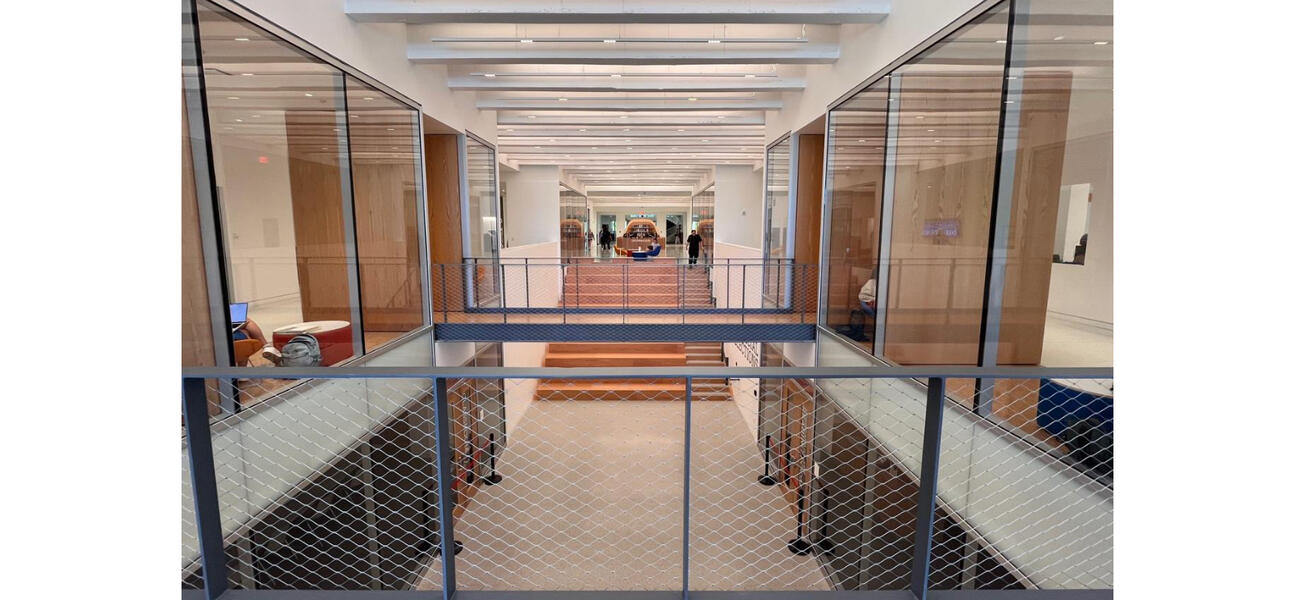
An Inviting Entrance
Courtesy of University of Arkansas
The popular west entrance connects the first and second floors and features a central service desk that is visible upon entry.
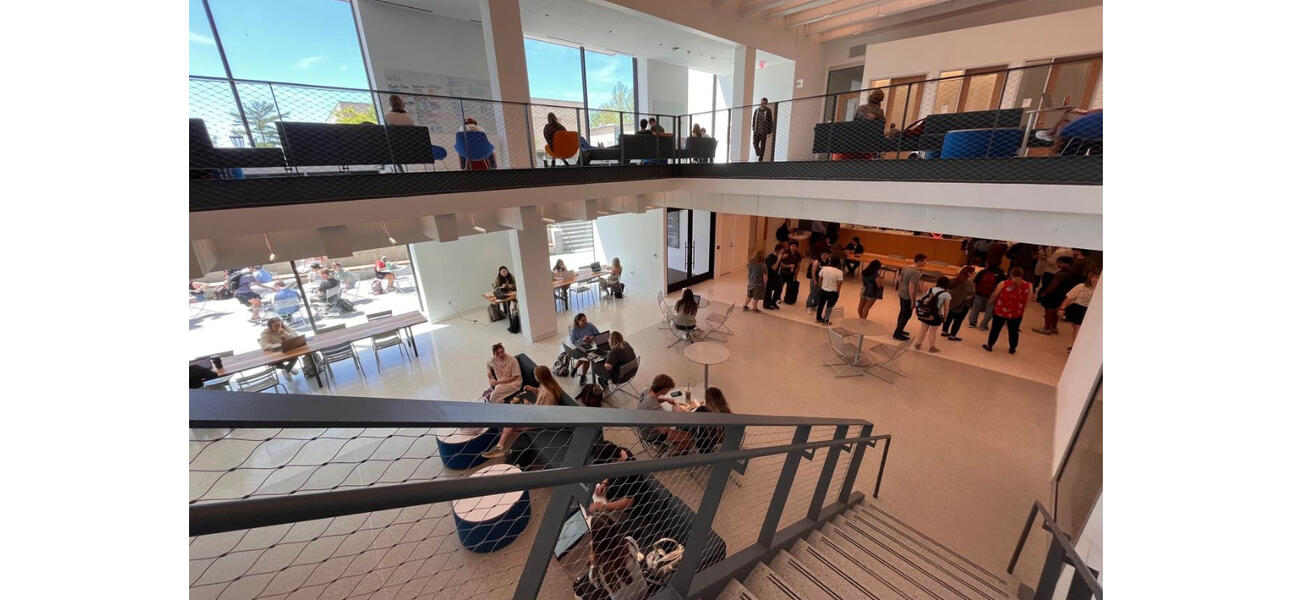
Café Connections
Courtesy of University of Arkansas
The newly excavated patio and second-floor windows provide natural light for the cafe on the first floor.
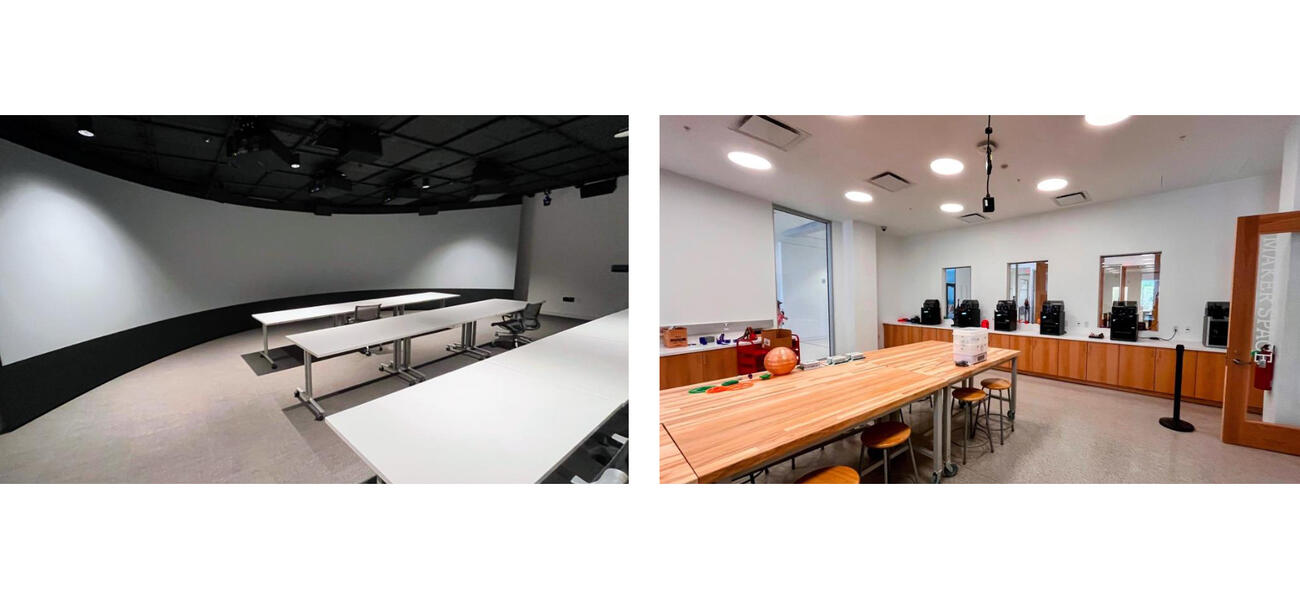
New Technology Spaces
Courtesy of University of Arkansas
The multi-disciplinary Experiential Learning department includes a data visualization room with a 180-degree, floor-to-ceiling screen, as well as a makerspace.
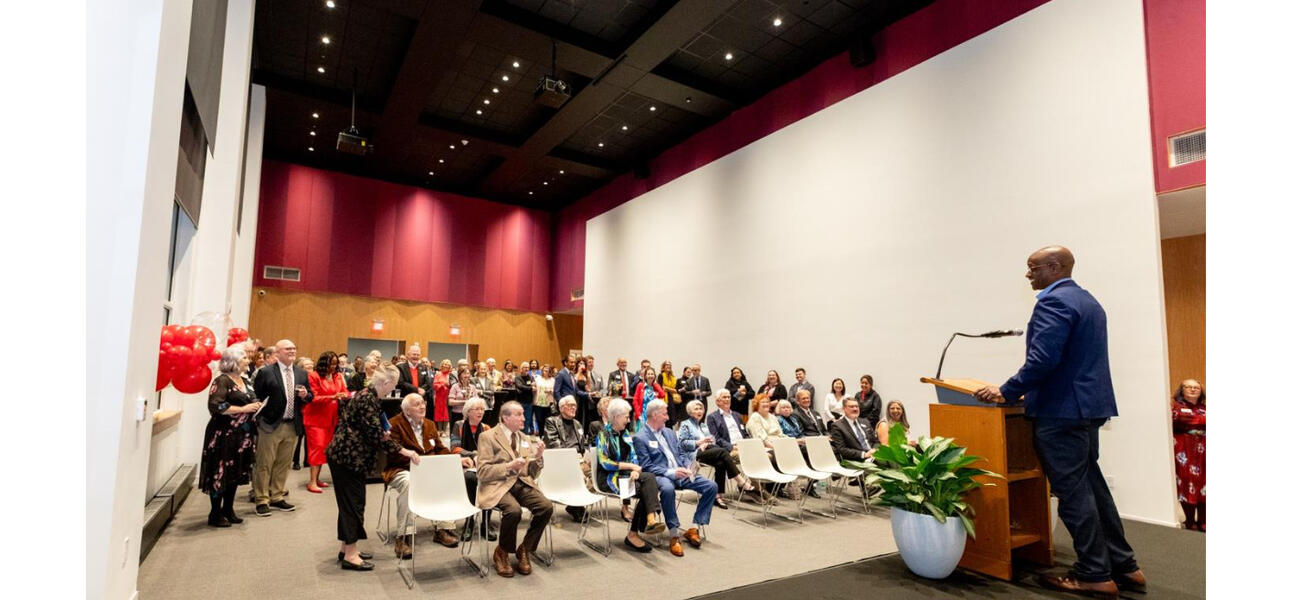
Soundproofed Event Space
Courtesy of University of Arkansas
Red acoustical soundproofing panels on the walls allow for large gatherings without disturbing nearby quiet spaces.
No longer a place to just study and shush, the modern university library is more like a buzzing connection point for the entire campus. At the University of Arkansas in Fayetteville, the recently renovated Mullins Library is no exception, with as many as 7,000 people going in and out every day. The largest of the U of A Libraries and central to the campus, the 300,000-sf facility now features new gathering spaces, new technology, and design updates that are adapted to the needs of today’s students.
Things have changed since the library opened in 1968, especially over the last several decades. Notably, the marked decrease in print collections and transition to online scholarship has dramatically changed how library space is used. Studies show that less than 10% of print collections circulate annually across general research libraries, and this number continues to fall. “We have also seen the growth of technology in research, the workforce, and in the classroom,” says Jason Battles, dean of libraries at U of A, who led the second phase of the renovation project.
While student needs are changing, the student body continues to grow. From 1968 to the fall of 2024, university enrollment has more than tripled from 10,549 to 33,610. Record enrollment in recent years has benefited the U of A Libraries with student fees that have helped fund improvements, while also posing the challenge of how a building designed for 15,000 students can now serve 34,000.
The other U of A Libraries include the Fine Arts Library, Physics Library, Chemistry and Biochemistry Library, as well as the Library Annex (LINX), a 27,000-sf, high-density, temperature- and humidity-controlled storage facility that was built in 2018. The majority of renovation involved the Mullins Library, with some minor updates to the Fine Arts Library.
Creating New Kinds of Spaces
The original 1968 Mullins Library structure was built with a square footprint, four floors—the first floor being underground—and lots of concrete. In 1997, the building was expanded with an addition on the east side. The recent renovation took place over multiple years in two phases, and was completed early in 2025, before the library re-opening in March.
The construction of the LINX facility helped make the Mullins Library project possible, as it allowed for less-used collections to be moved out of the library so that space could be repurposed for individual study, group study, and classrooms. Phase 1 of the renovation involved $28 million in updates for floors three and four, with 1,200 seats added.
Phase 2 covered floors one and two, and was all about finding ways to increase engagement and connection throughout the library. This is where Battles came onto the project and was tasked with enhancing existing service and programming spaces, along with creating new technology-rich spaces, all with a budget of $40 million. “You don’t get a lot of opportunities like this to truly re-envision what a library is and what it can be on campus,” he says.
One of the main goals and challenges of Phase 2 was to bring more light into the first floor, which was previously on the basement level and had no entry point. This involved cutting through concrete on the west side of the second floor to bring light down to the first floor, and heavily excavating outside the basement level to create a cafe patio, along with new windows. The cafe patio, now at ground level, serves as another entry point that increases both engagement and accessibility. Landscaping on this side of the building involved smoothing out existing concrete steps in order to make pathways there more accessible, as well.
As a result of the work on the west side of the building, the main entrance of the library is now open, overlooking the first floor with more natural light. The main service desk has also been moved to be central and visible upon entry, another goal of Phase 2.
As another priority, redesigning the floor plan and reducing staff space has made “back-of-house” processes more efficient, so that collections can be moved around on the same floor.
A Special Place for Special Collections
Just because the library is new and improved doesn’t mean it’s lost touch with history. In fact, from the very beginning of the project, the team prioritized Special Collections and tried to find ways to make this area more engaging. Previously, it had been hidden from view behind a solid wooden door. After Phase 2, it is much more visible in the center of the first floor, with a museum-like exhibit room, classroom, reading room, and vault.
“We even have an exhibit gallery window that goes into the vault space, so you can see what is happening behind the scenes from the cafe,” says Battles.
Special Collections features rare and unique materials, from works of renowned architects to Miss America dresses. Students can access these materials in the classroom and reading room, which are both connected to the vault. All of these rooms are temperature- and humidity-controlled, so that materials can be moved freely and safely. The vault also has a walk-in freezer unit specifically for microfilm storage that is kept at 35 degrees and 30% humidity.
Another technical update to this area is the addition of a dual-action fire sprinkler system, which helps to prevent accidental water damage to collections.
Experiential Learning with Technology
If the first floor seems like a traditional library, the second floor is more like the library of the future. Here, a hub of various technologies serves multiple disciplines, all in close proximity to encourage connection. Technologies include: augmented/virtual reality (AR/VR), audio recording, data visualization, podcast booths, video capture/green screen, and a makerspace. Together, these spaces have become the Experiential Learning Department, which has been staffed by faculty librarians, graduate students, and student workers.
“What makes this library unique is that all of these technology spaces are collocated,” says Battles. “Some institutions may have one or more of these spaces, but not all of these spaces together in one place.”
The makerspace has the usual tools, such as 3D printers, a laser cutter, and a vinyl cutter, but it also has various craft-oriented tools, like sewing machines and button makers, blending old and new technology. A hand-cranked printing press will soon be available.
Technology itself is the draw, but thoughtful design makes this area even more engaging. The immersive data visualization room is outfitted with a 180-degree, floor-to-ceiling, curved screen, which is set up to project on three screens in the main library hallway, so that someone walking by can get a glimpse of the action. In both the makerspace and AR/VR studios, glass was used on walls to encourage engagement between spaces. The nearby audio recording studio is large enough so that a small class can learn production skills, and yet also has a single-instrument practice room.
Because technology is always changing, flexibility was built into the design. “One of the reasons we chose to use projection screen technology in data visualization, rather than LED or OLED screens, was mainly cost, but also flexibility,” says Battles. “Having pop grids and changing out projectors and screens is a lot easier than rebuilding if you had hard digital screens.”
Across the way from the technology hub is the 2,500-sf event space, which is soundproofed with large acoustical panels, allowing for boisterous gatherings without disturbing studying students.
Overall, the renovations have been remarkably successful at adding value and interest to the existing building while accommodating a much larger student body with bigger and technology-rich spaces.
“A history class in the Special Collections classroom pulling materials for discussion, a lively outdoor café concert, librarians doing a virtual reality demonstration, a faculty luncheon in the event space—there is so much diverse engagement in the facility at the same time,” says Battles. “When you have students doing Instagram posts from within the library, I think that’s a great sign.”
By Joy Lin
Learn more about how to make the most of your legacy facilities at the Tradeline Facility Renovations & Repurposing Conference. Join us in Boston in October!
| Organization | Project Role |
|---|---|
|
Kennedy & Violich Architecture, Ltd.
|
Architect of Record
|
|
deMx Architecture
|
Architect
|
|
Con Real, LLC
|
General Contractor
|