
Tradeline's industry reports are a must-read resource for those involved in facilities planning and management. Reports include management case studies, current and in-depth project profiles, and editorials on the latest facilities management issues.
Latest Reports
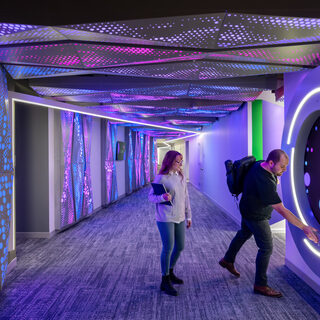
Empowering AI-Ready Research Environments
Artificial intelligence is no longer a futuristic concept; it’s a transformative force actively reshaping how research is conducted, how buildings are designed, and how energy is consumed. From self-driving labs—defined as laboratories where scientific systems can autonomously perform multiple cycles of the scientific method—to smart energy systems, AI is ushering in a new era of efficiency, collaboration, and complexity. This shift was evident in a series of think tank sessions hosted by SmithGroup’s Science & Technology, Artificial Intelligence, and Energy Advisory Board, where leaders from academia, private industry, the energy sector, design, engineering and planning explored the rapid evolution of AI and its impact on research environments. In just six months between sessions, the pace of change was striking: Half of the experts expressed openness to selective technological enhancements, an idea nearly all had rejected earlier. This growing acceptance signals a more tangible AI-driven future, though strategies around governance and energy are still emerging. The following report offers insights into how AI is transforming research ecosystems, the energy infrastructure needed to support this growth, and the challenges and opportunities ahead.
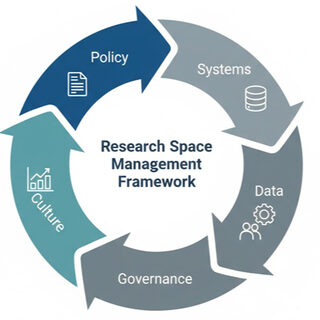
Transforming Research Space Management for a New Era
In an era of expanding research portfolios and heightened expectations for interdisciplinary collaboration, universities face intensifying pressure to strategically plan, manage, and optimize research space. Research facilities, wet labs, maker spaces, core facilities, and computational suites, represent some of the most limited and costly assets in the academic environment. As competition for high-quality laboratories and specialized rooms grows, institutions are re-evaluating entrenched practices, strengthening policy frameworks, and adopting data-driven systems to ensure that space is allocated efficiently, transparently, and equitably. The most successful universities treat research space not as a static inheritance but as a strategic resource that must evolve with the institution’s mission.
Emory University Integrates Massive High-Technology Equipment into the Design of its New Health Sciences Center
More and more universities are building their scientific research centers around cores of huge, heavy, yet surprisingly delicate equipment. Building a core laboratory facility forces architects and campus planners to think about logistics, timing, and backup systems to a level of detail probably more familiar to NASA engineers than institutional architects. As the team behind Emory University’s new Health Sciences Research Building II (HSRB-II) learned, a huge range of factors—in their case, everything from the amount of rebar in the flooring to the width of the corridors to shipping velocity on the Suez Canal—must be reckoned with before such a facility is completed.
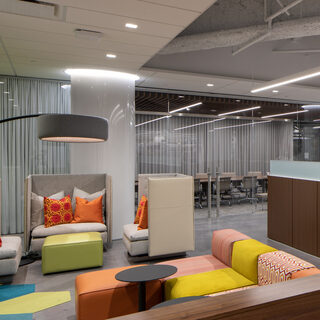
Incorporating Advanced Labs into Urban Commercial Buildings
Designing and building labs in the unlikely and constrained location of the prestigious Pacific Design Center (PDC) with Hollywood as a backdrop is a daunting task, requiring adherence to quality expectations, facilities management guidelines in a non-research environment, separation from existing high-end tenants, and compliance with infrastructure requirements. Cedars-Sinai, one of the largest nonprofit medical centers in the U.S., accepted the challenge after deciding to expand its research portfolio. Growing beyond its limited campus is necessary to accommodate the rapid growth of its research facilities and to aid in recruiting top scientists by providing innovative facilities with optimum resources. Hospital officials looked a half mile from their campus to the PDC, a designated cultural resource building complex designed by Cesar Pelli in the 1970s. Known in the 1980s and 1990s as a vibrant hub of premier art, design, and architectural showrooms, many of the tenants now have online shops rather than physical space in the cluster of buildings, leaving vacancies available for lease and an opportunity for Cedars-Sinai’s growth.
Fred Hutch Cancer Center’s Space Realignment Sheds 30,000 sf, Saves Roughly $4 Million
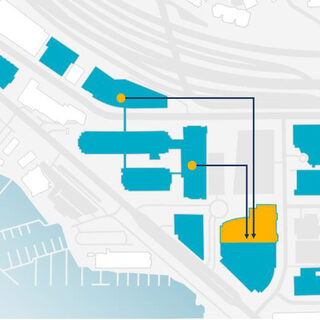
In the span of 16 months, Seattle’s Fred Hutch Cancer Center formulated and implemented a space realignment initiative that divested 30,000 sf of leased space, generated $2 million in savings and another $2 million in cost avoidance, and impacted approximately 1,400 people, 20% of its 7,000-member workforce.