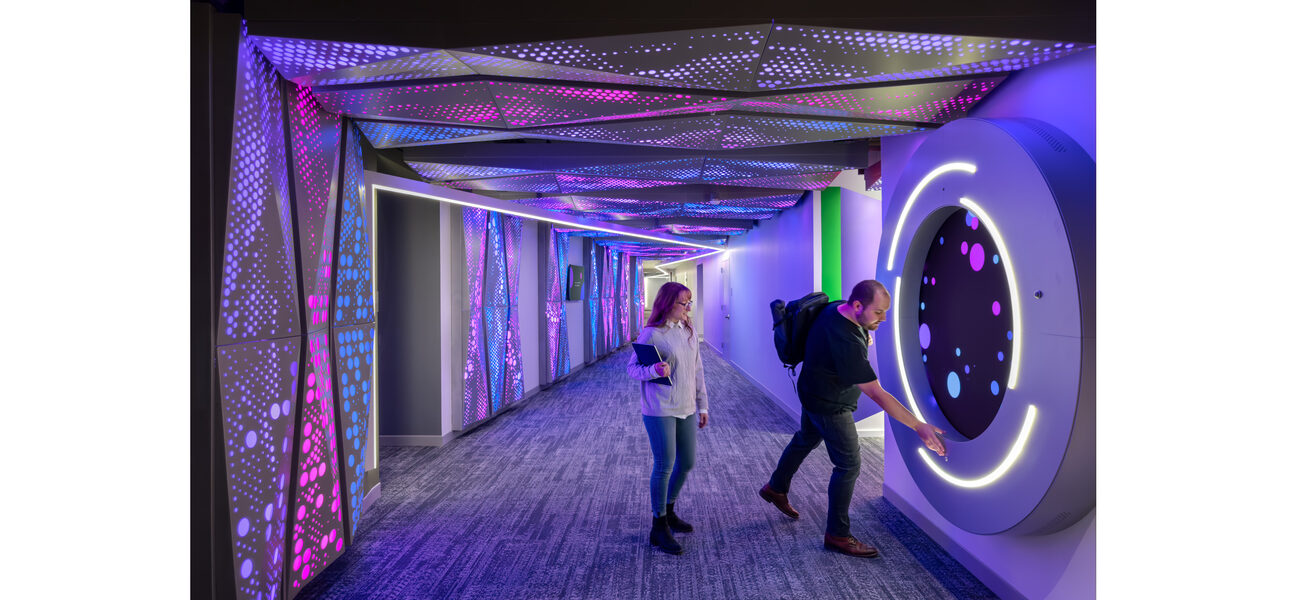
Yale University’s Wu Tsai Institute for Human Cognition
Photo by Anton Grassl, courtesy of SmithGroup.
A virtual portal connects research facilities across the campus.
Artificial intelligence is no longer a futuristic concept; it’s a transformative force actively reshaping how research is conducted, how buildings are designed, and how energy is consumed. From self-driving labs—defined as laboratories where scientific systems can autonomously perform multiple cycles of the scientific method—to smart energy systems, AI is ushering in a new era of efficiency, collaboration, and complexity. This shift was evident in a series of think tank sessions hosted by SmithGroup’s Science & Technology, Artificial Intelligence, and Energy Advisory Board, where leaders from academia, private industry, the energy sector, design, engineering and planning explored the rapid evolution of AI and its impact on research environments. In just six months between sessions, the pace of change was striking: Half of the experts expressed openness to selective technological enhancements, an idea nearly all had rejected earlier. This growing acceptance signals a more tangible AI-driven future, though strategies around governance and energy are still emerging. The following report offers insights into how AI is transforming research ecosystems, the energy infrastructure needed to support this growth, and the challenges and opportunities ahead.
The Research Revolution
AI’s evolution has been swift and undeniable: AI assistants are becoming a default; ChatGPT is quickly taking over search and productivity tools; and driverless vehicles on the roads are becoming more commonplace. Less visible to the layperson, but just as transformative, is the way AI is redefining how research gets done.
AI holds the potential to supercharge research by reducing human error and managing enormous swaths of data. But there’s a catch: It struggles to distinguish between good and bad data. Legacy data can be stored in hard-to-locate files; it presents in inconsistent formats; and it can contain incorrect conclusions, or simply be of poor quality—all factors that set an unstable foundation for AI, undermining its potential from the start.
Addressing data integrity is the next critical frontier. Some institutions are already implementing in-house processes as a salve. Barbara Manley-Smith at Augusta University shares that they have instituted a five-step model for data reporting: Aggregate > Report > Analyze > Act > Improve.
“When we can pull out validated data,” says Geo Adam, global head of pRED Facilities and Infrastructure Projects at Roche, “then the revolution can start.”
Buildings Will Evolve
As AI reshapes research, it’s also transforming the physical spaces where research takes place. As robots take on more of the tasks traditionally carried out by humans, the built environment will shift, too.
Robotics Support Systems—Powerful machines require building support, including:
- Charging stations and areas for mechanical maintenance
- New or enhanced loading areas to help autonomous vehicles get to work
- Upgraded systems to manage taxing electrical loads and heat output
Interior and Building Conditions
- Structural loads will need reassessment to account for the added weight of machines.
- Interior lab layouts will need to be reconfigured to accommodate new workflows, like pathways that facilitate the movement of automated carts. These spaces will be more compact than they are now, as machines enable more efficient work with fewer spatial demands.
- Lighting strategies may shift—robots don’t have the same needs as humans.
The Role of Humans
The built environment as we know it was created primarily for people. For now, humans are still in the room with humanoid robots, often as supervisors. But as these machines become more reliable, buildings may need to accommodate human needs less and less.
As humans continue to share research spaces with machines, the marriage of humans and tech will necessitate technological enhancements for humans that will help the two coexist (as example, eyewear or headsets that allow for humans to navigate in the dark).
“We have an opportunity to define what being human is uniquely, and what our value in this new world will be,” notes Chris Tidrick, CIO at Gies College of Business and former chair of the Gen AI Solutions Hub at University of Illinois Urbana-Champaign.
The Energy Equation
A lab’s performance is only as good as its environment. Proper maintenance and fastidious building management are critical, and AI is helping, with intelligence integrated directly into buildings. These tools monitor key areas like energy use, maintenance schedules, and HVAC, and respond to building needs in real time. That’s an efficiency win, and—though securing the resources for facilities upgrades is a challenge—an even bigger win for ROI. But engineers and planners will need to anticipate different technological issues than they have in the past, with systems, buildings and research moving heavily to dependence on AI.
There’s a significant roadblock to this arc of progress, though: Today’s infrastructure is not prepared to keep pace with the speed of AI development. The extra strain these new resources put on energy also make the conversation around finding sustainable energy solutions all the more urgent. Thermal energy networks (TENs)—using the waste heat from data centers to power the grid—offer a promising and low-carbon solution. Investment will be needed to push systems into this new era.
The Organizational Challenge
Envisioning a different future, and then successfully moving toward it, is not an easy task. Risk tolerance spans the spectrum, and running into resistance across siloed departments is common. There are competing needs within large organizations, and only so many resources. The successful implementation of long-term projects like AI integration depends on keeping motivation consistent across the many changes that will unfold: administrative transitions, shifting political climates, evolving cultural perceptions. Bottom line? Advocating for something shrouded in uncertainty requires strong leadership and a clear vision.
It also demands cooperation across policy, planning, research, and operations. Augusta University has taken steps toward securing this long-term support by introducing an AI department, a move that other organizations will likely soon follow.
Final Thoughts
Participants in the think tank sessions agreed that the upsides of AI proliferation are huge: Greater efficiency, productivity, accuracy, and speed of output are at our fingertips, if these tools are put into place correctly.
Data quality, and correcting for data bias, must be reckoned with. Upgrading energy infrastructure that can keep up with the swelling computational demand of AI is a must, and it will require sustainable solutions. But with the right alignment of governance, vision, and investment, the revolution is already underway.
By Adam Denmark, Science & Technology strategist/director of Lab Planning, SmithGroup
Dr. Katrina Kelly-Pitou, director of Climate Adaptation and Economics, SmithGroup
Stet Sanborn, director of Climate IMPACT, SmithGroup