Tradeline's industry reports are a must-read resource for those involved in facilities planning and management. Reports include management case studies, current and in-depth project profiles, and editorials on the latest facilities management issues.
Latest Reports
New Technologies Enable Repurposing Academic Buildings into Labs
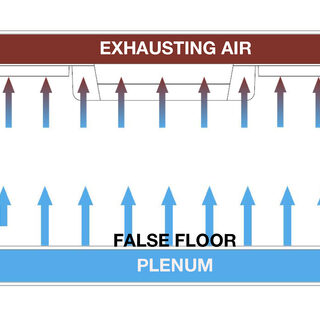
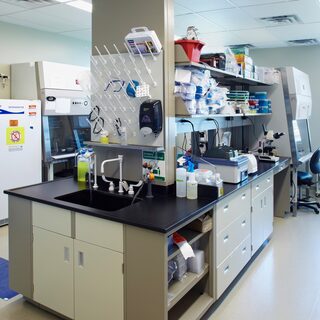
New analytical planning tools and HVAC technologies can dramatically ease the transformation of existing academic buildings into high-performance state-of-the-art science labs. Along with advances in quantitative methods to assess the potential of existing space, innovations in HVAC strategy offer compact and energy-efficient solutions that are well suited to campus structures erected for different purposes decades ago.
Edmonton Clinic Health Academy
The six-story, 578,000-sf Edmonton Clinic Health Academy (ECHA) at the University of Alberta, Canada, brings together 800 faculty and staff from 12 departments, and 6,000 students from the Health Sciences Department, who focus on population health, computational research, and translational research.
Survey Points to Continued Slow Growth in Academic Research Space
Research space at academic institutions increased 3.5 percent from fiscal year 2009 to 2011, one of the lowest two-year growth rates since a peak in 2001-03, according to the National Science Foundation's (NSF) most recent Survey of Science and Engineering Research Facilities. In that time period—the most recent data the NSF has—institutions planned fewer projects, and fewer projects came to fruition, an indicator that this "slow growth" trend will continue. The main growth area continued to be the biological and biomedical sciences.
Project Demand and Market Stability Expected to Escalate Capital Construction Costs
Continued signs of stable economic growth indicate that the recovery is gaining momentum in many parts of the United States and Canada. Construction selling prices for institutional projects grew at a 6 percent annualized rate in 2012, on top of a 3 percent increase in 2011. Construction costs are expected to continue stabilizing and rising in many regions as market confidence and capital spending increase.
Peter Irving Wold Science Center
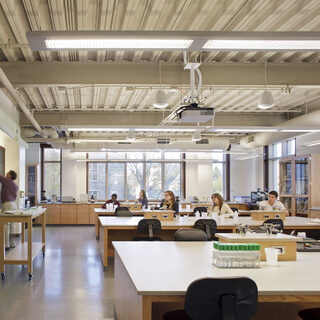
The three-story, 42,000-gsf integrated teaching and research facility includes state-of-the-art laboratories—supporting biochemistry, environmental science and engineering, computer engineering, and acoustical engineering—as well as general-use classrooms. The central organizing atrium with its popular Science Café is both a thoroughfare and destination. Labs and classrooms open off the atrium, with progressively quieter zones for study and faculty office suites extending away from the atrium.