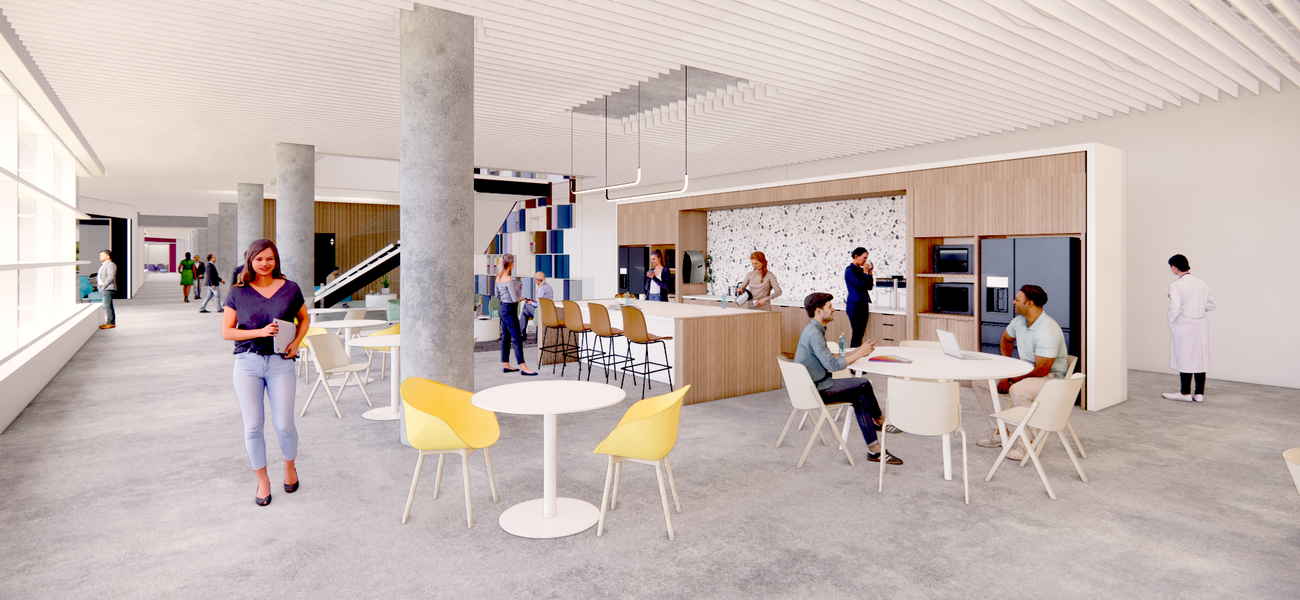
Work Cafés
Courtesy of HGA
A central space in Sherwin-Williams’ new Morikis Global Technology Center contains work cafés that encourage impromptu collaboration by drawing researchers out of the labs so they can connect and collaborate with colleagues.
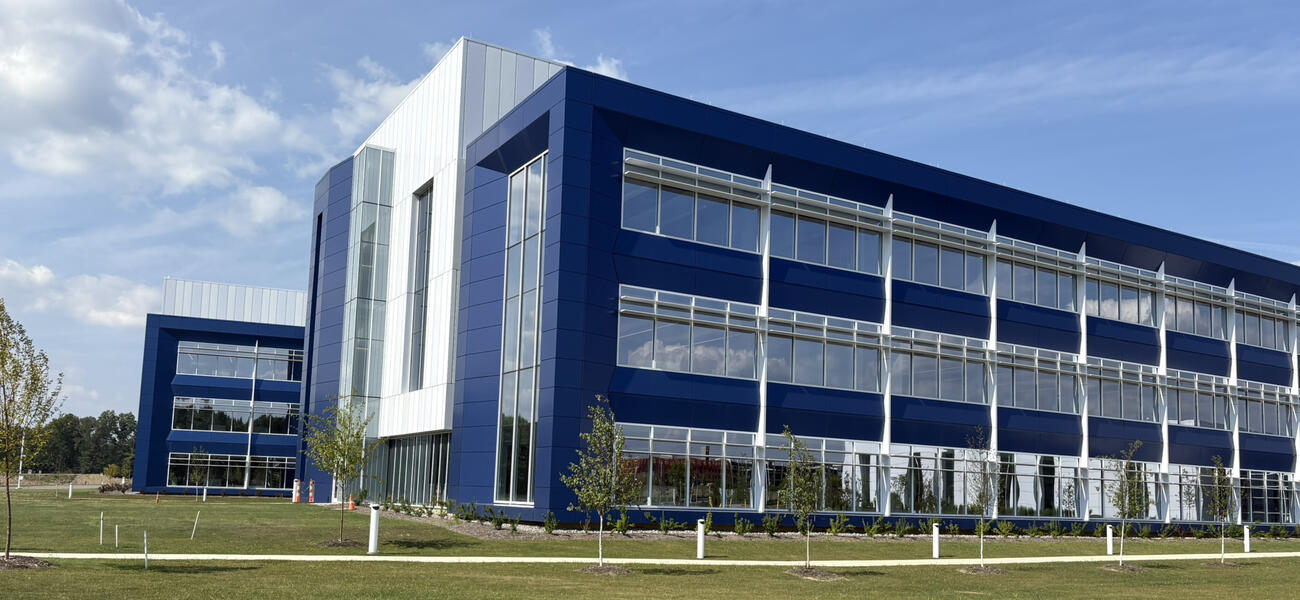
Exterior Coating
Courtesy of HGA
The sapphire blue exterior of the new Global Technology Center serves as a showcase for the expertise that Sherwin-Williams has in developing durable and attractive products.
To maximize scientific synergies and encourage innovation, The Sherwin-Williams Company made the decision to combine two of its largest R&D organizations into a new global R&D center in Brecksville, Ohio. The 600,000-sf facility, named the Morikis Global Technology Center, began hosting some 900 Sherwin-Williams employees—including chemists, engineers, technicians, and support teams—upon opening in December 2025. One of the big goals is to take people from disparate business units that have been historically scattered across multiple buildings and bring them together into a space designed to maximize collaboration and spark creativity.
Physical change often goes hand-in-hand with organizational change. At Sherwin-Williams, that meant finding ways to increase utilization of spaces and equipment by sorting and combining various functional groups of researchers into nine synergistic neighborhoods. “We identified these lab synergies based on understanding the people, understanding their equipment, and understanding their activities,” says Jeffrey Puleo, planning principal at HGA Architects.
HGA developed this understanding of work processes and material flows not only by speaking with employees and analyzing survey data, but also by using a 3D spatial mapping system from Matterport to photo-document how spaces were being utilized at the legacy R&D facilities.
The maps played a crucial role in identifying opportunities to improve efficiency in how materials were stored. By changing the way in which materials were stored and managed, Sherwin-Williams was able to reduce storage space by over 50,000 nsf while still storing the same amount of raw materials, consumables, and finished goods in a much smaller footprint.
Even as Sherwin-Williams took action to use physical space more efficiently, the company also improved its enterprise systems in the digital realm. “We created a digital tool for lab bench chemists that lets them order raw materials and have the facility team deliver it directly to them,” explains Diana Strongosky, senior vice president of global innovation at Sherwin-Williams. “Instead of running around to find the raw materials, the chemists in the lab can stay at the bench and perform the value-added product development work. By using this digital tool to facilitate centralized raw material management, we reduced waste, increased efficiency, and made things easier for our chemists. Overall, it was an excellent return on investment.”
Putting L&D with R&D
Sherwin-Williams offers a lot of learning and development (L&D) opportunities for employees who work both at their headquarters and at their current R&D facilities. HGA performed a study that looked at utilization of spaces used internally for collaboration, as well as the costs of renting space at conference centers and hotels. “By providing a detailed analysis of the demand load, the room sizes, the frequency of training sessions, and the size of the L&D cohorts, we showed Sherwin-Williams there would be a tangible ROI from putting dedicated L&D space into the new R&D Center,” says Peter Balistrieri, principal architect and practice group leader at HGA.
Strongosky notes that there’s an additional advantage to having L&D facilities integrated both into the Center and into a new global headquarters campus that Sherwin-Williams is building in downtown Cleveland. “What’s nice is that there will be a lot of cross-pollination of people—both R&D employees and people from headquarters—coming to the new Global Technology Center for training. This will give people who work at headquarters more opportunities to learn about the research that underpins our products,” she says.
Stepping Up to the Benches
HGA executed the designing and programming stages of the Center during the COVID pandemic and thus was unable to perform in-person Gemba walks—Lean management practices where leaders walk through workplaces to directly observe how work gets done—at existing Sherwin-Williams R&D centers. Still, by using Matterport’s 3D spatial mapping system to essentially perform virtual Gemba walks, HGA was able to uncover valuable quantitative insights, including variation in the amount of space assigned to each laboratory scientist at legacy Sherwin-Williams facilities.
“At one of the older R&D facilities, we found laboratories and benches with only 4 linear feet per researcher, while another facility gave researchers as much as 15 linear feet each,” says Puleo. By testing a series of mockups for bench designs and interviewing subject matter experts at Sherwin-Williams, HGA standardized 10 linear feet as the appropriate amount of bench space that each researcher would need to accommodate the necessary equipment.
Beyond the benches themselves, researchers do need additional space for support activities. To design these spaces, HGA took a modular programmatic approach, calculating, for example, that light chemistry labs would need 360 sf per researchers, while heavy chemistry labs would require 420 sf per researcher to provide additional space for fume hoods.
While Sherwin-Williams took a uniform and consistent approach to providing researchers with the lab space necessary to do their best work, the company also looked for ways to improve efficiency by making sure spaces would be properly utilized. “Not everybody who works in R&D uses a lab bench every day,” says Strongosky. “In particular, managers or directors might need to use these types of spaces only a few days per week. When we looked at people who were using lab benches only 25% of the week or less, we found they could share a lab bench space with colleagues or just use an open lab bench.” Through this analysis, Sherwin-Williams realized that the company could support the same number of R&D staff with about 50 fewer lab benches, allowing them to reduce the total lab space in the Center by about 30,000 gsf, which saved approximately $21 million in construction costs.”
Finding Efficiencies Through Consolidation
Again and again, HGA and Sherwin-Williams found that they could improve efficiency by consolidating scattered facilities into unified spaces within the new Center, for example:
- A 14,000-plus-nsf analytical lab with 10% more space than the half-dozen analytical labs scattered across the legacy R&D facilities – “Utilization is key when it comes to analytics,” explains Balistrieri. “Usually, people are your highest cost, unless you’re talking about analytical equipment, which can cost quite a bit of money at the high-end microscopy scale. If equipment is over-utilized, that can slow down throughput, so we wanted to build in some breathing room for Sherwin-Williams to add staff and instrumentation as needed to meet the future needs of internal and external customers.”
- A 16,200-nsf testing lab, where technicians can perform environmental tests using equipment such as quantitative energy dispersive X-ray spectrometry devices that accelerate weathering of samples to check durability of various coatings – Sherwin-Williams formerly had about 18,000 nsf dedicated to testing labs at a smattering of locations within its legacy R&D facilities. The company was able to reduce the net square footage needed for testing equipment by about 10% in the immediate term, but included 7,000 nsf to accommodate future growth for new testing equipment to see, for example, how well its coatings stand up to salt spray, salt fog, and other challenging conditions.
- A 35,500-nsf application space with specialty areas for automotive applications, building materials, brush and roll, and spray that will give Sherwin-Williams a greater ability to demonstrate how and where its coatings can be applied to different substrates – The new application space has a 40% increase in spray capacity in a space that’s only about 22% larger than the combined net square footage of all the previous application spaces in the legacy R&D facilities.
“We had about 350,000 nsf of space in all of our existing R&D sites,” notes Strongosky. “With careful programming and attention to detail, we were able to put together a new program for a 387,000-nsf facility at our new Global Technology Center. That’s a 9% increase in space, but it gives us room to grow and also incorporates a number of new program elements, including an innovation center, a Learning & Development Center, the collocated analytical center, and consolidated testing hub.”
Embodying Sherwin-Williams’ Culture, Celebrating Its Prowess
Sherwin-Williams has an open and collaborative culture, so HGA designed a central space between the labs and the service side of the building filled with collaboration zones in the form of “work cafés,” to bring people out of the labs and give them opportunities to form impromptu connections with one another and with individuals from the service functions. Outdoor spaces such as courtyards also provide an environment for employees and even customers to mix and mingle.
“We’ve been implementing a center of excellence strategy for years,” says Strongosky. “Now, by bringing all these different R&D capabilities and services together in one building, we are finally able to realize this goal and benefit from the resulting efficiency gains.”
By Aaron Dalton