Tight Mechanical Space
Courtesy of University of Georgia
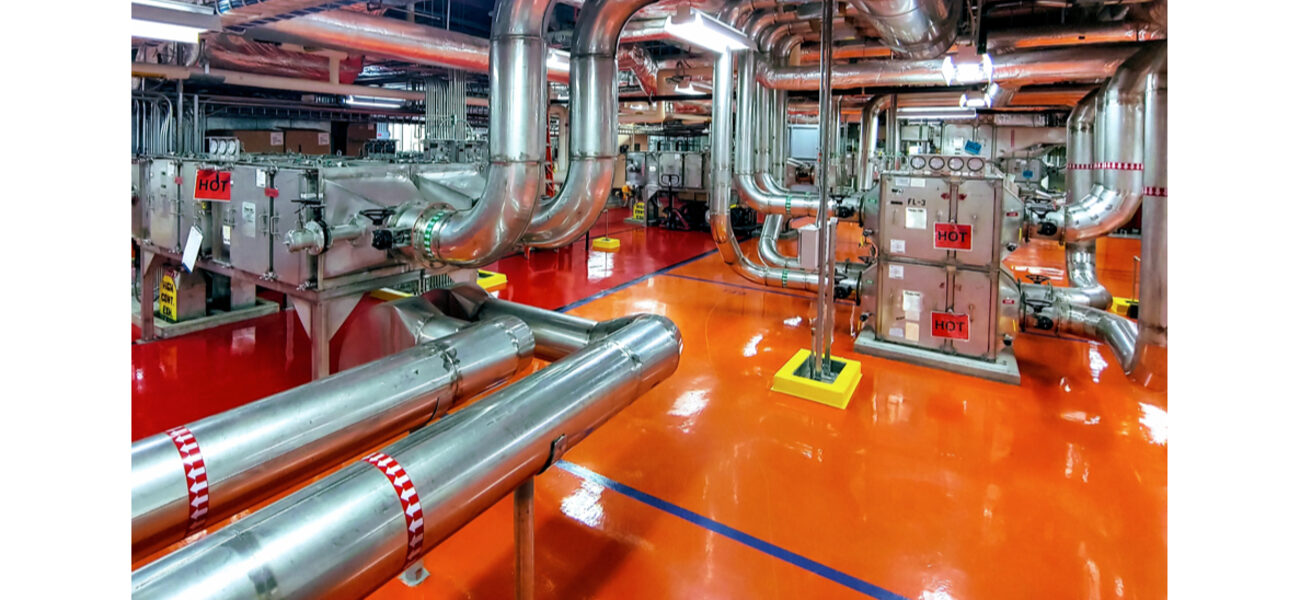
The project team renovating a portion of the Animal Health Research Center at the University of Georgia in Athens, Ga., for a fermentation lab worked within the constraints of this mechanical space to add utilities to meet the needs of the new lab.
Animal Health Research Center
Courtesy of University of Georgia
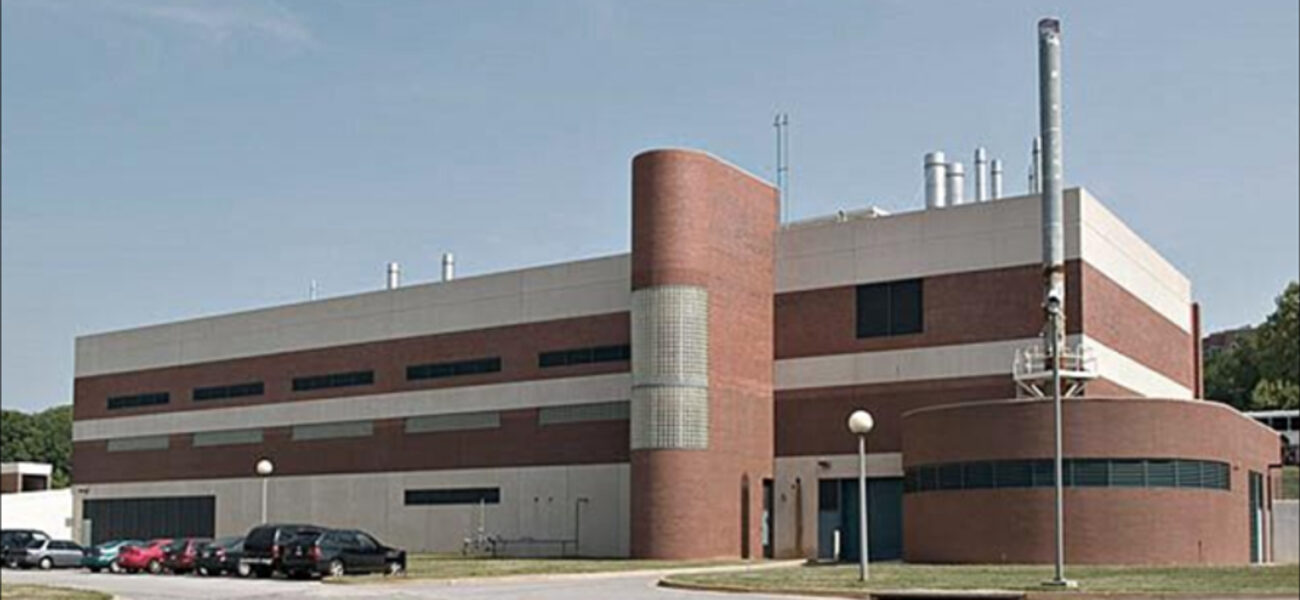
To accommodate a planned fermentation lab for an industry partner, the Animal Health Research Center at the University of Georgia in Athens, Ga., renovated an existing 349-sf ABSL-3 lab in the 75,000-sf biocontainment facility to support BSL-2 fermentation needs. The partner ended up not using the space.
When it was proposed in 2019, repurposing underutilized space at the University of Georgia for an industry partner’s fermentation lab appeared to be a good deal for everyone involved. It was a win for the pharmaceutical company that wanted to contract with the university to help it develop new products and needed a fermentation lab that met, at a minimum, biosafety level 2 (BSL-2) standards. It was a plus for staff at the university’s Bioexpression and Fermentation Facility who would perform the work. It represented an advance for the university that wanted to form new industry relationships and had available space at its Athens, Ga. campus inside the Animal Health Research Center (AHRC). And it was a win for the AHRC, a 75,000-sf biocontainment facility that would host a new industry partner in addition to other laboratories performing BSL-2, animal biosafety level 2 (ABSL-2), biosafety level 3 (BSL-3), animal biosafety level 3 (ABSL-3), and animal biosafety level 3-agricultural (ABSL-3Ag) research work.
The plan was clear—renovate a 349-sf ABSL-3 laboratory in the AHRC, ensuring renovations maintained ABSL-3 laboratory standards, which are familiar to building managers, to accommodate three large fermentation units and supporting utilities. The process to get there, however, suffered delays that ultimately led the industry partner to withdraw from the estimated $1 million project four months after it began.
The university continues to seek a tenant for the now-completed ABSL-3 lab space. While this industry partnership did not go as planned, the experience provides powerful project management lessons, says Hannah Payne Walker, operations director at the AHRC:
- Set up a robust communication network that touches every stakeholder at every step of the project, starting when preparations begin. This gives opportunities to both inform the stakeholders about details and progress, and to provide the managers and end-users a chance to detect if there are issues with the scope of work or project details before the project progresses too far.
- Establish a backup financial plan in case unexpected circumstances interrupt the original funding model. For example, if the space owner is using a cost-recovery model, discuss every expenditure required for the lab and include that (with the cost of inflation) in per-diem usage rates.
- Evaluate alternative uses for the project space before it begins. This provides managers “Plan B” options if the original tenant decides not to occupy the space.
- Be conservative when projecting timelines. This goes for everything, from equipment delivery to construction timelines to staff training, says Walker. “If you’re estimating it to take two to three years, add on some time on the back end for something to go wrong, because we all know something will go wrong. If there is any associated facility training or new protocols that you have to train your users or yourself on, do that as early as you can in the game,” says Walker.
An Optimistic Project Start
To Walker, her team’s experience in operating and maintaining environmental control systems to regulate parameters such as temperature, humidity, ventilation, air purification, and lighting, made the AHRC a good candidate for the fermentation lab project. For example, the AHRC building has an effluent decontamination system. It’s a facility where staff are used to wearing personal protective equipment and managing their entries and exits from secure spaces. And it had space to house three 30-liter fermenters for scientists to work safely with cells, viruses, and bacteria.
“A high-containment research facility is such a highly specialized building. When you find an opportunity to involve new clients and meet new research needs, that’s where the excitement for me really came from,” says Walker.
“We agreed to provide all of our established BSL-2 enhanced protocols and all the associated training that came with that,” she says. “Ultimately, this was a controlled lab space for them to produce this product for the industry leader, and we had strong controllability of environmental parameters like temperature, humidity, and lighting. They were also very happy to have extra biosecurity and biosafety [safeguards].”
Planning for the project included three phases that started in September 2021. First—mechanical space alterations, including the installation of utilities and piping to the new lab space—lasted through March 2022, as the AHRC remained active. Second, from November 2021 to January 2022, came lab-level alterations, including concrete coring, scheduled to occur during the AHRC annual performance verifications (testing to ensure lab spaces are compliant with biosafety regulations). The third phase, which involved installing the fermentation units, was scheduled for July 2022 to July 2023, before the lab space was set to go live.
“Originally, the estimated timeline for this project was about 10 to 12 months, and our full downtime ended up being only about nine weeks, which is about four or five weeks longer than we are normally shut down to accommodate an annual verification process for biocontainment systems,” says Walker. The choice to maintain ABSL-3 construction standards added additional shutdown time, says Walker.
The project placed mechanical utilities equipment for the new lab within the building’s existing mechanical space to ease future access for service and maintenance, says Walker. But placing utility lines was tricky: They needed to run in spaces that would not interrupt the high-containment areas serving existing animal labs. The team decided to run pipes down into the sterile cagewash room adjacent to the new lab space. “That supplied an added level of biocontainment, biosafety,” says Walker. “It also ensured that if there were to be a leak from any of the mini-penetrations, it was still within our containment zone. If the other penetrations were to leak into the mechanical space, you have that dilution factor.”
Another factor was ensuring the new lines did not interfere with the building’s biosafety regimens.
“Our facility performs all of its own gas decontamination of our lab spaces. So, all of the mechanical space walkways needed to stay clear, and we needed to maintain access to all of the decontamination ports associated with the animal rooms and our exhaust HEPA banks. We tried to keep everything as close to the lab as we could to try to reduce the amount of piping and tubing that we needed to penetrate down into the new lab space below,” says Walker.
Equipment Delays, Communication Challenges
Supply chain delays that characterized the COVID-19 pandemic paused the start of the project, says Walker, and additional delays occurred when the fermenter units were damaged upon delivery. Installation of the fermenters also stalled when representatives for the manufacturer, unfamiliar with a high-containment lab space, delayed their work until lab managers documented the safety protocols in place to protect visitors working within a biocontainment building. In addition, specialized parts that the new lab space required took longer to deliver than expected.
Then there were communications disconnects with other stakeholders.
“We experienced a lot of inefficient communication,” for a project that required many skilled and highly technical personnel, on both the contractor side and in the biofermentation group, as well as administration and biosafety, says Walker.
And because there were so many stakeholders—from the industry partner, the fermentation lab, the AHRC, the university, vendors, permitting authorities, different laboratory teams—it became difficult to coordinate communication with everyone, says Walker. “We were rehashing conversations. We were changing decisions. All of those things led into probably the most painful challenge we experienced, and that was delays,” she says.
Another challenge arose as staff from the fermentation labs learned about working in a high-containment facility, including rules about bringing supplies into the containment area and wearing protective clothing. Not everyone was enthusiastic about the training required to work at the AHRC, and not everyone communicated their willingness to cooperate, says Walker.
The experience led to another contingency lesson for the AHRC team: “If you have highly specialized people on your team or the lab staff, consider what happens if those people leave, especially if you’re counting on them to train the people coming in. Have a backup plan,” says Walker.
The series of delays—in equipment delivery, project start, staffing coordination—all contributed to the industry partner backing out of the project, says Walker.
What the Team Got Right
A key decision that the project team made was to maintain ABSL-3 construction standards throughout the project instead of delivering lab space that was suited only to BSL-2 agents required by the industry partner. “We could have chosen to downgrade the one lab to BSL-2, but decided to maintain our ABSL-3 standards since, one, that is what we know, and two, there was uncertainty about future project needs,” says Walker.
“It resulted in allowing us to maintain a lot of the versatility and flexibility of that space,” says Walker. “We could actually remove those fermentation units and slap in an IVC (individually ventilating cage) rack and continue doing our ABL-3 studies, because there were no infrastructure changes here, other than just piping in some new pipes to that space.”
This decision should help the AHRC to find new users for the space, says Walker. “We’re having ongoing discussions about future versatility. Could we potentially use this for BSL-3 [fermentation] work, and what additional facility construction would we need to do to be able to support that within federal and state regulations?”
Two out of the three fermentation units ended up being moved to the fermentation lab to support projects that don’t require the use of an effluent decontamination system like that at the AHRC. “Although I’m happy they are able to get use out of these machines, we are left wondering if this space will ever be used as a fermentation lab,” says Walker
By Michael S. Goldberg
Related article: Creating BSL-3/ABSL-3 Research Space in Existing Facilities