Adaptive Reuse

Carnegie Mellon University Opens Robotics Innovation Center

Published 3/23/2026

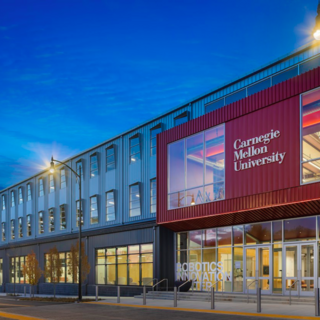
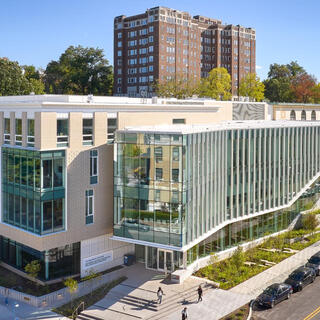
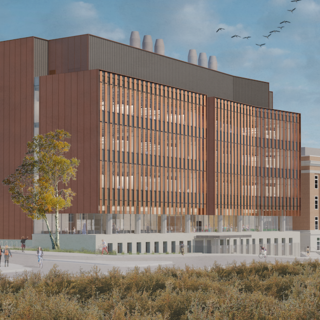
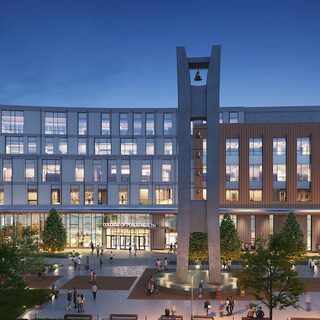
Carnegie Mellon University celebrated the opening of the $100 million Robotics Innovation Center (RIC) in late February of 2026. Located at Hazelwood Green, the site of a former steel mill in Pittsburgh, the 150,000-sf facility embodies the evolution of that industrial heritage by uniting programs in robotics, automation, and artificial intelligence under one roof. Perkins Eastman's vision for the three-story structure created flexible high-bay research spaces and R&D venues that can address robotic systems at different scales.

Read More

Carnegie Mellon’s Highmark Center Raises the Bar for Athletics, Health, and Wellness Facilities

Published 3/17/2026

Carnegie Mellon University’s Highmark Center for Health, Wellness and Athletics represents the largest in a series of recent initiatives designed to enhance the student experience and boost the university’s competitive appeal. It also marks a definitive break from the old “sink-or-swim” posture that characterized campus environments across the country for decades. 

Read More

Construction Continues on UCLA Research Park

Published 3/4/2026

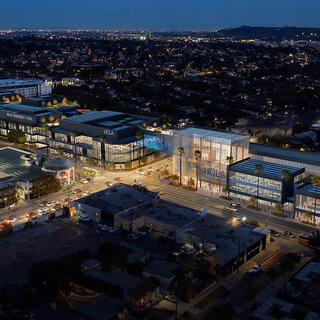
The University of California, Los Angeles is constructing the UCLA Research Park to create an engine of innovation and economic growth for Southern California and beyond. The visionary project is transforming the former Westside Pavilion shopping mall into a dynamic destination where basic scientists join with industry experts to advance discovery and commercialization. Acquired by UCLA in December of 2023, the property encompasses more than 1.3 million gsf on 9.2 acres, with two main buildings spanning a total of 700,000 sf connected by an enclosed pedestrian bridge.

Read More

Dry Labs Produced by Large-Scale Renovation Equip Medical Center for Growth

Published 3/3/2026

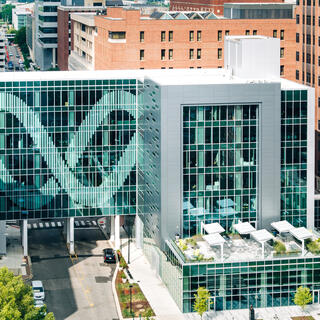
The University of Alabama at Birmingham’s (UAB) Altec/Styslinger Genomic Medicine and Data Sciences Building (ALGEN) is the product of a down-to-the-concrete renovation that transformed an aging, nondescript health sciences research facility into a modern, light-filled home to seven floors of four different dry lab phenotypes. The building is topped by an executive floor that, for the first time, brings together key leadership of the university’s health system and Heersink School of Medicine (HSOM). Fresh glazing on an expanse stretching over a busy downtown street creates a striking double helix pattern that telegraphs the building’s mission. A newly constructed conference center adjoins the renovated structure.

Read More

Return on Mission: Rethinking Space and Purpose in Higher Education

Published 2/3/2026

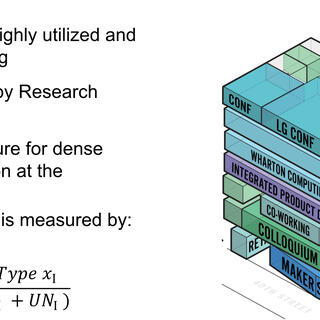
In a higher education landscape facing shifting enrollment trends, rising costs, and an uncertain future, institutions must rethink how they use their physical spaces—not just as real estate, but as engines of purpose. And rather than traditional return on investment (ROI), they should employ “Return on Mission” to evaluate their success rather than metrics like net-to-gross ratios, utilization rates, and physical occupancy to assess their spaces. Relying solely on ROI falls short of capturing what truly matters: the activity inside the space and the value it generates.

Read More

Engineering Next: OSU’s Master Plan for a Future-Ready Campus

Published 1/6/2026

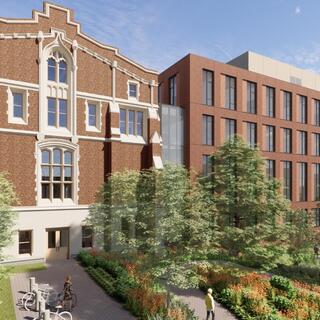
The Oregon State University College of Engineering is embarking on a transformative journey to optimize space, enhance research capacity, and create a cohesive environment for students and faculty. Through strategic planning, innovative redesigns, and an emphasis on community engagement, OSU is redefining how legacy buildings can serve modern needs without massive new construction. A major focus of the 10-year plan centers on the university’s “engineering triangle,” a cluster of historic buildings dedicated to engineering research and education. These century-old buildings, while rich in history, are in desperate need of modernization to support the university’s cutting-edge research. While previous years have seen new construction, the next phase will focus on preserving and enhancing existing spaces.
Read More

Management and Communication Lessons from a Stalled Lab Renovation

Published 12/3/2025

When it was proposed in 2019, repurposing underutilized space at the University of Georgia for an industry partner’s fermentation lab appeared to be a good deal for everyone involved. It was a win for the pharmaceutical company that wanted to contract with the university to help it develop new products and needed a fermentation lab that met, at a minimum, biosafety level 2 (BSL-2) standards. It was a plus for staff at the university’s Bioexpression and Fermentation Facility who would perform the work. It represented an advance for the university that wanted to form new industry relationships and had available space at its Athens, Ga. campus inside the Animal Health Research Center (AHRC). And it was a win for the AHRC, a 75,000-sf biocontainment facility that would host a new industry partner in addition to other laboratories performing BSL-2, animal biosafety level 2 (ABSL-2), biosafety level 3 (BSL-3), animal biosafety level 3 (ABSL-3), and animal biosafety level 3-agricultural (ABSL-3Ag) research work.

Read More

University of Minnesota Opens Chemistry Undergraduate Teaching Laboratories

Published 11/13/2025

The University of Minnesota opened a reimagined undergraduate chemistry education facility in October 2025 on its Twin Cities campus in Minneapolis. Transforming the historic Fraser Hall, a 97-year-old law library, the $144.7 million project comprised the demolition of selected portions of the building, 30,730 gsf of renovation, and 91,350 sf of new construction. A mechanical penthouse was also created. 

Read More

Building Next-Gen STEM Facilities for Long-Term Viability

Published 11/12/2025

Academic STEM facilities need the flexibility to accommodate an expanding range of disciplines and pedagogical methods while equipped with an adaptable infrastructure responsive to occupancy shifts and technology advances. Today’s projects often span the complexity spectrum, from soft spaces and graduate student workstations outside the lab to a zero-point energy (ZPE) environment for quantum physics research or an engineering lab housing a wind tunnel. While the terms “flexibility” and “adaptability” are often used interchangeably to describe the requirements of a lab building, planners at Research Facilities Design (RFD) draw a clear distinction between the two. In their context, flexibility is what occurs below the ceiling, for example, movable casework that allows a lab to accommodate new equipment or new research opportunities. Adaptability refers to what happens above the ceiling, such as robust MEP systems, well-organized ductwork and piping racks, and spare capacity at the electrical panel to support new or expanded programs in the building. 

Read More

Temple University Opens College of Public Health

Published 10/31/2025

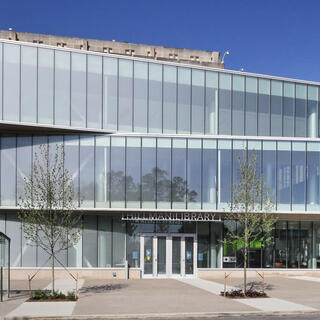
Temple University officially opened a $125 million facility for the Christopher M. Barnett College of Public Health in October of 2025 in Philadelphia. Designed by SLAM and PZS Architects, the adaptive reuse project transforms the former Paley Library into a five-story nexus for innovation and academic excellence. The 306,000-sf building offers active learning classrooms, research suites, and offices, as well as a student loft and the Aramark Community Teaching Kitchen.

Read More

SAC Health Opens Brier Campus

Published 10/21/2025

SAC Health opened the Brier Campus in September of 2025 in San Bernardino, Calif. Designed by Perkins&Will, the $85 million outpatient facility is expected to accommodate 300,000 patient visits over the next five years to address regional health disparities. The five-story structure provides comprehensive primary care and specialty services, including internal medicine, pediatrics, orthopedics, dentistry, family medicine, ophthalmology, and women’s health.

Read More

Oregon State University Builds the First Mass Plywood Lab Building in the U.S.

Published 10/14/2025

Mass timber construction is widely lauded for its sustainability benefits, including wood’s natural carbon sequestration, lower embodied energy footprint, lighter weight compared to steel or concrete, and essential renewability. But does it pay off in terms of a university’s performance standards and cost concerns when embarking on a project as ambitious as Oregon State University’s Jen-Hsun and Lori Mills Huang Collaborative Innovation Complex, a $213 million, 143,000-sf facility dedicated to advanced programs in artificial intelligence, robotics, energy, and materials science? Scott Ashford, OSU’s dean of the College of Engineering, and Libby Ramirez, the university’s resident architect, argue that with careful strategy and an eye toward the data, the answer is “yes.”

Read More

University of Pittsburgh Constructs BioForge

Published 10/6/2025

The University of Pittsburgh is constructing the state-of-the-art BioForge center in the Hazelwood Green development, a brownfield site site that once accommodated a steel mill. Designed by HOK, the $250 million hub will drive breakthroughs and innovations in the manufacturing of precision biological medicines to improve human health. The 185,000-sf building will fill a critical gap in the local biotechnology ecosystem by addressing production constraints and cost-based obstacles to the wide distribution and accessibility of novel treatments.

Read More

Jacksonville Jaguars Transform Everbank Stadium

Published 9/30/2025

The Jacksonville Jaguars broke ground in February of 2025 on a $1.4 billion renovation of Everbank Stadium. Created in partnership with the City of Jacksonville, the project will reimagine the facility as a year-round destination for sports, entertainment, and community connection. The vibrant hub will benefit from the addition of a partial roof cover, enlarged and elevated concourses, corner openings to improve airflow, and a reflective outer coating to reduce interior heat.

Read More