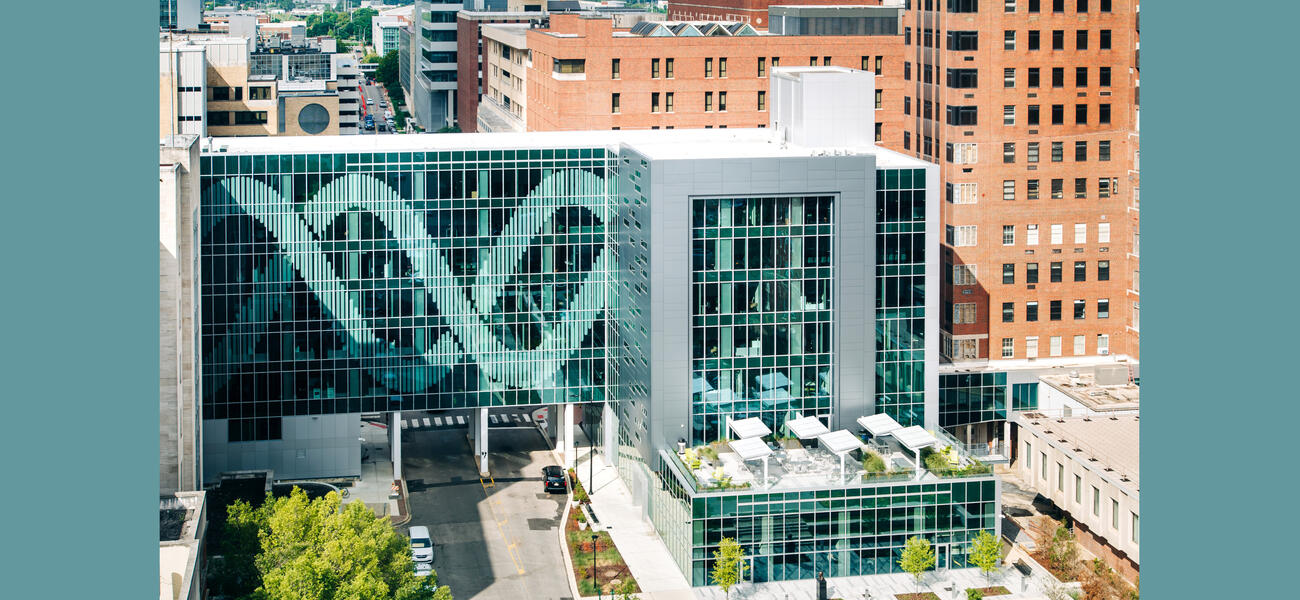
ALGEN
By UAB Photographers
The $78 million renovation that produced ALGEN entailed roughly 50 enabling projects on the urban UAB campus.
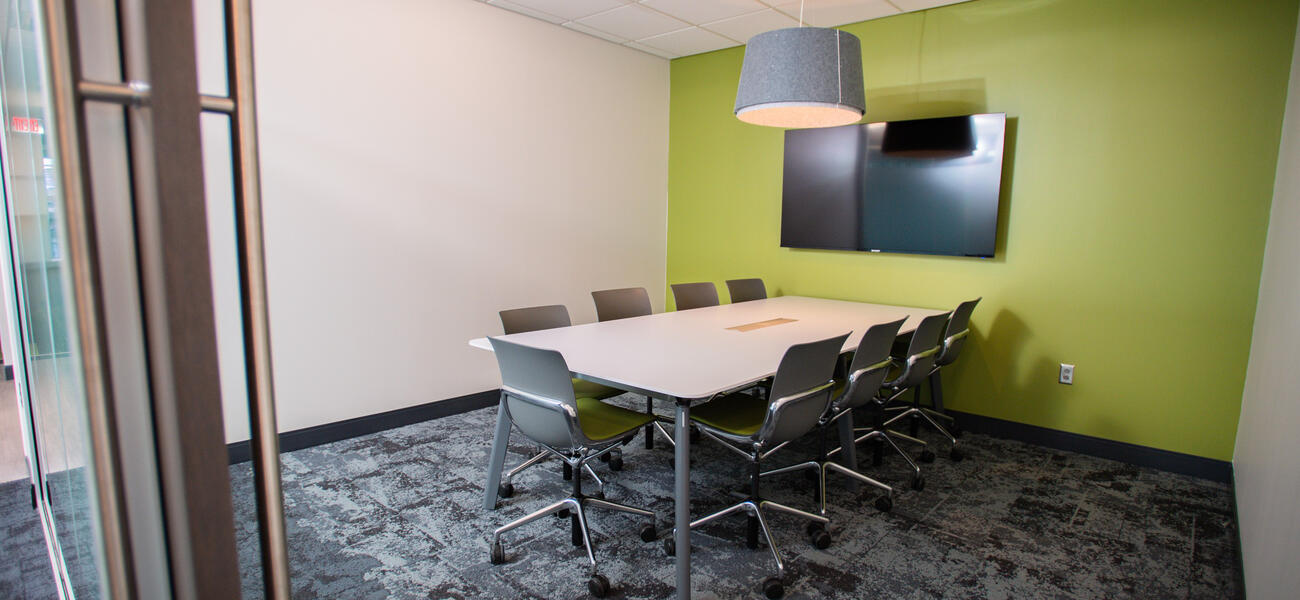
Huddle Room
By UAB Photographers
Simplicity and flexibility were key goals in designing Altec’s dry labs.
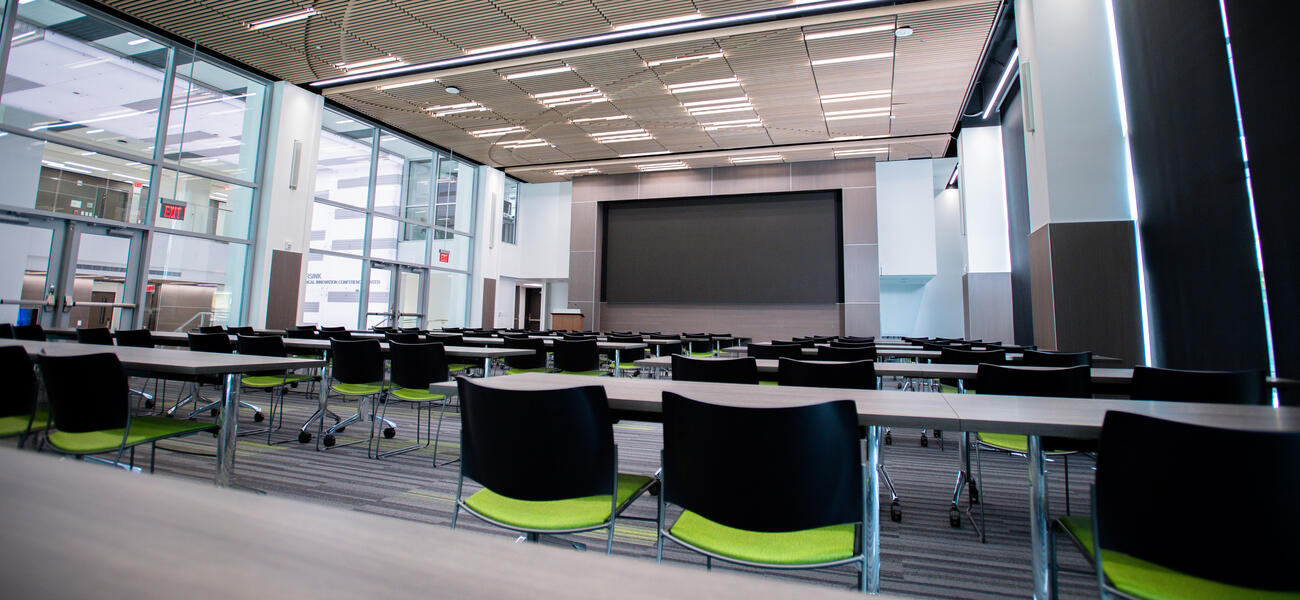
Conference Center
By UAB Photographers
The new conference center adjacent to ALGEN has a two-story display screen on the ground level and a shaded terrace atop the fourth floor.
The University of Alabama at Birmingham’s (UAB) Altec/Styslinger Genomic Medicine and Data Sciences Building (ALGEN) is the product of a down-to-the-concrete renovation that transformed an aging, nondescript health sciences research facility into a modern, light-filled home to seven floors of four different dry lab phenotypes. The building is topped by an executive floor that, for the first time, brings together key leadership of the university’s health system and Heersink School of Medicine (HSOM). Fresh glazing on an expanse stretching over a busy downtown street creates a striking double helix pattern that telegraphs the building’s mission. A newly constructed conference center adjoins the renovated structure.
Opened in late 2025, the 145,000-sf ALGEN is the result of a 2017 campus master planning initiative to maximize space utilization as the medical school embarked on the path to expand its research enterprise.
“If you stall on your recruiting, you’re going to start going backwards,” says Kevin Bell, former UAB executive director, Project Management, emphasizing the key role facilities play in attracting new hires. “We wanted to set the tone for current and future occupants that this is an advanced environment that we hope will encourage better research. The recruiting effort is constant, and space is a ‘lens’ to understand the organization.”
A Communal Vision
The master plan identified the site of ALGEN’s predecessor as the heart of the research district, with convenient access to other HSOM research, and pedagogical and clinical facilities. This proximity made it ideal for the intended focus on translational medicine, taking science from the benchtop to the public. Looking at the future of healthcare, leadership saw significant opportunities for discovery in biomedical data sciences, including the broad field of genomics and the emerging field of precision medicine. This became the research direction of the renovation project. The potential to attract funding also played a part in the decision.
Once funding was secured in 2021, planning sessions with the future occupants produced a communal vision of what the revamped space should look like and what it needed to do. An iconic appearance, an activity-based layout, and design elements that conveyed a forward-thinking tone were high on the priority list, as was the inclusion of administration and support personnel. Sustainability and recycling of original materials were also important, along with features to bolster recruiting efforts: a bike station, showers, and lactation and wellness rooms. Cube farms and server farms were non-starters, and the original windowless, austere corridors that bisected the 900-foot-long floors had to go.
“We had to make major alterations,” says Bell. “Construction crews removed a staircase and cut holes through the floor to centralize heating and air conditioning. They tore out bundles of cabling that had been installed in the corridors over the years. Wet labs and the animal facility on the top floor were demolished, and most of the utility connections—to city water, fire water, and electrical connections to the transformer—were reengineered and replaced..”
Four Phenotypes
Before the reconfiguration plans got specific, the medical school leadership identified four phenotypes encompassing 15 tenant groups as the future occupants: informatics and computational, centers and institutes, clinical research support, and information technologies support.
While these groups all perform their work in dry lab spaces that can look much like conventional offices—including cubes, carrels, and huddle rooms—Bell points out that each of the ALGEN phenotypes has different space requirements. Having the opportunity to understand the needs of the individual and community user groups early in the process enabled the design team to create floor plans that use space more efficiently and avoid the need for future modifications.
“We could have simply adopted a cookie-cutter ratio of cubes to offices, but that wouldn’t have met the needs of the various research teams,” says Bell.
Given the awkward dimensions of the building floorplate—a width less than half its 900-foot length—the layout of each floor alternates the location of offices along the perimeter so that all occupants can enjoy natural light.
The third floor, with its corridor connecting the Heersink Conference Center with four other buildings, was a natural location for many centers and institute phenotype tenants. One side of the floor accommodates the Medical Scientist Training Program and the Physician Scientist Development Office, servicing more than 80 physician-scientist trainees working on dual M.D. and Ph.D. degrees, who need hotel spaces, whether a cube or a private office. A lounge with both hard and soft seating is often populated by Gen Z students accustomed to working almost anywhere on their laptops, observes Bell. The area also has a small classroom. At the other end of the floor, the Marnix E. Heersink Institute for Biomedical Innovation and the Marnix E. Heersink Institute for Global Health share a differently configured suite, with more offices and cubes. A highlight is the Innovation Clinic, whose goal is to optimize clinical processes, develop innovative technologies, and explore new business models by addressing high costs, enhancing accessibility, and improving the quality of care. All furniture in the 1,030-sf room is movable, so the space can easily be reconfigured. The use of virtual reality technology enables surgeons in the room to train medical students halfway around the globe in new surgical techniques.
The fourth and fifth floors, housing the informatics and computational phenotype, are predominantly open plan. The research space typically consists of one principal investigator (PI) office and four cubes, with several carrels for students. Workstations abut the perimeter on the longer sides of the building, but floor-to-ceiling windows make the space bright and airy.
The clinical research support floor is designed to serve a staff of roughly 30, with many more cubes than offices. Blocks of dedicated workstations taller than a typical cubicle, with sound-absorbing panels along the glass-lined perimeter, serve as a home base for clinical care coordinators, who often work on site in the hospital or clinic. Meeting rooms and phone booths provide private space for occasional visits from the group’s PI or industry data managers. Additionally, there are two offices for management. The clinical data-gathering mission creates the need for significant file storage, much of which is still paper-based. Instead of being scattered in various locations around the floor, lockable file cabinets are consolidated in one large lockable room. The entire suite is locked as well, offering several layers of protection for confidential information.
The information technologies group on the first floor is a welcome inclusion in the computer-intensive facility, providing IT support for many building tenants. Technicians have large workstations (8 by 8 feet) to accommodate all of their equipment—as many as eight monitors and four PCs for troubleshooting or rebuilding. A handful of meeting rooms and huddle spaces are available for collaborating with investigators to develop hardware and software solutions, along with a storage room for equipment.
“It’s a pretty cool thing to have this key resource on site,” says Bell. “It is very much a part of our dry lab ecosystem.”
Bringing People Together
Another noteworthy feature is the nugget ice maker located in the break room on each floor—a practical and refreshing amenity. The machine produces chewable ice, a favorite refreshment in the South, explains Bell, adding, “It’s amazing what a popular attraction this is.”
With several casual eateries nearby, it was deemed unnecessary to offer food service on site, other than vending machines, but ALGEN has other features to eliminate silos and draw people together. Many of the floors have been designed without suites to enable the free flow of traffic and expand visibility from one space into another. Shared resources and common rooms create the opportunity for impromptu interaction, and the shaded terrace is an appealing place to meet or refresh.
The biggest gain for intermingling, however, stems from collocating staff from different research groups. As Bell explains, principal investigators will certainly gain from being more accessible to each other, but they tend to collaborate regardless of physical barriers. Staff, on the other hand, will significantly improve their knowledge and skills by collaborating with other teams.
With its six different spaces, the new Marnix E. Heersink Conference Center offers other opportunities for mingling and collaboration. Its 2,750-sf grand ballroom has a double-height first floor in order to fit a giant screen in its main meeting room, where seating for up to 250 is flexible, not fixed. The lobby area is available for poster sessions, symposiums, and receptions. The second and third floors have an assortment of rooms for up to 50 people, and breakout areas. A shaded terrace tops the third floor and, like other center space, can be rented for special functions. The final rentable space includes a park designed for outdoor functions.
Many of the conference rooms outside the Conference Center are tied into the school-wide reservation system maintained by the dean’s office, allowing use by outside departments for groups of up to 35 people. The conference rooms are strategically located, so users coming from elsewhere do not have to enter the office area. ALGEN occupants have reciprocal privileges in other campus buildings.
Conference rooms can become ownership-oriented and subsequently were only occasionally used, says Bell. “The genesis of this system is the school’s original space master plan developed in 2018 to make the best use of our space.”
Getting There
The path to ALGEN’s opening was a complex process that required multiple enabling steps. A SWOT (strengths, weaknesses, opportunities, and threats) assessment of its predecessor in 2016 concluded that, despite deficiencies, the building was vital to HSOM growth. The medical school space master plan was developed with input from a broad focus group the following year, and in 2019 a targeted focus group helped shape the results of a feasibility study for the building renovation. Having so many faculty and staff involved provides not only better designs but also many champions for such large initiatives.
The original structure, almost 100% occupied and split roughly 50/50 into wet labs and offices, had to be vacated before construction could start.
“We had to optimize space assignments and renovate enough wet lab space as part of our facilities master plan to relocate users without affecting our overall strategy,” notes Bell.
The need for office space was resolved by modifying the Lyons Harrison Faculty Office Tower. Shrinking the office size, taking down a few walls to provide open office areas, and using modern furniture almost doubled the building capacity, to 100 people per floor, making it large enough to accommodate many of the occupants of ALGEN’s precursor. Still, some faculty had to move into temporary quarters before their new offices were ready.
The space master plan was indispensable throughout, emphasizes Bell.
“We had quite the matrix of things to do before construction, over 50 enabling projects,” he says. “The layers of relocation are quite deep, requiring us to borrow space from the hospital and UAB central administration. The last group to go into their final location will happen in October of this year. There was no way to decant the building without the master plan, knowing where to put people and what renovations were necessary.”
The completed ALGEN has a capacity of 675 workspaces, but “the number of people actually serviced could double given the prevalence of hybrid and remote work,” comments Bell.
Have UAB’s plans for the future changed in the current research environment?
Together, UAB employs about 13,000 people and HSOM about 12,000. The medical school has about 400 investigators representing some $600 million in research across different funding portfolios.
“We will continue to recruit regardless of whatever obstacles are in front of us,” concludes Bell.
By Nicole Zaro Stahl