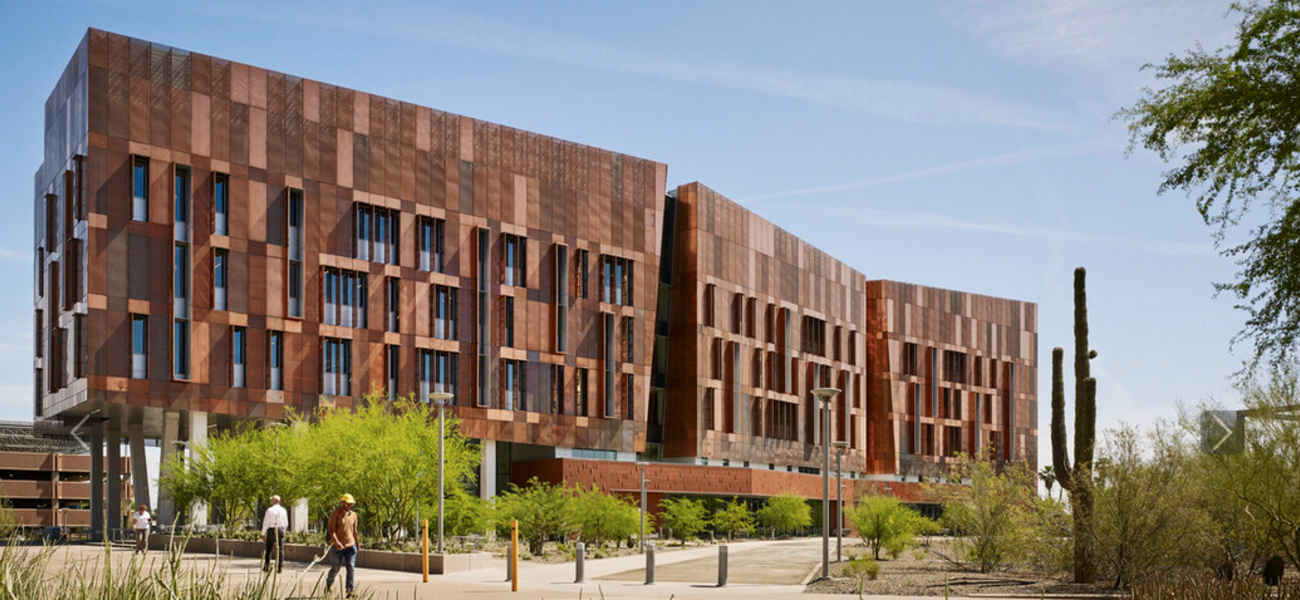
Biodesign C
Courtesy of Arizona State University and ZGF Architects
With its mix of science and technology occupants, ASU’s Biodesign C exemplifies the way cross-discipline workhorse buildings can lift the lab-to-gross ratio, in this case greater than 30%.
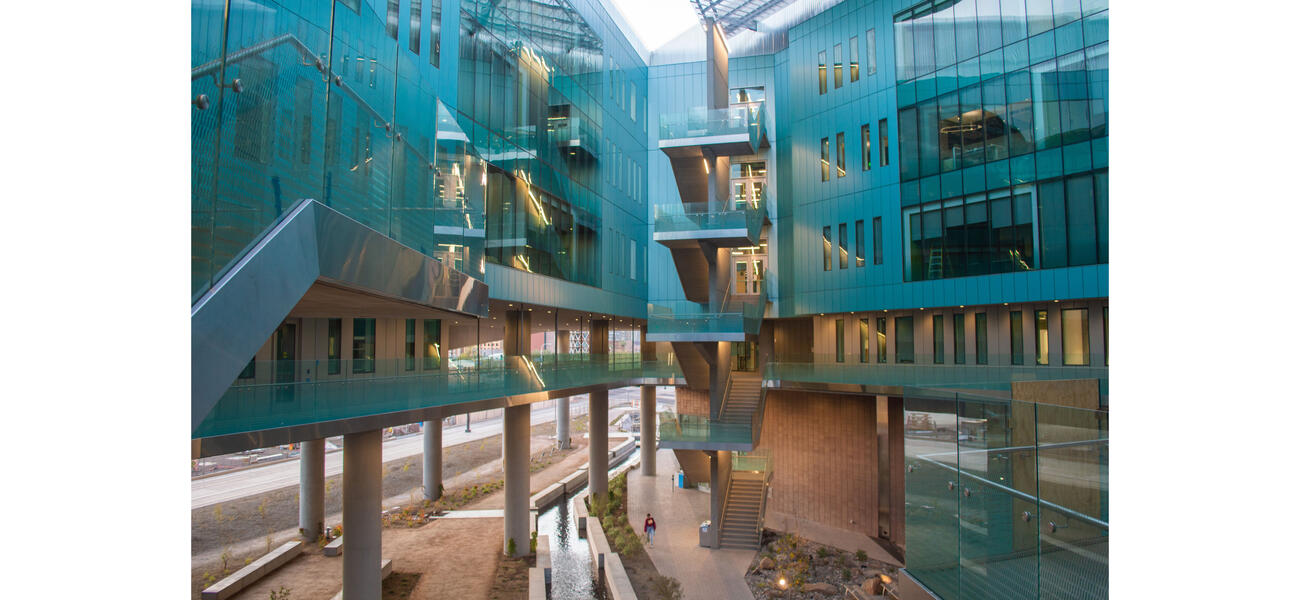
Atrium of Center for Planetary Health
Courtesy of Architekton/Grimshaw
Illustrating ASU’s interdisciplinary approach to research facility design, the 281,000-gsf Rob and Melani Walton Center for Planetary Health, completed in December 2021, houses research labs for biological sciences, engineering, life sciences and sustainability, along with dry lab space that includes computing, cyber-security, engineering design and fabrication, and robotics.
Facing the mandate to grow university research expenditures to $1 billion by 2028, Arizona State University’s (ASU) Research Space Planning group was charged with determining how much lab space would be required to meet that goal and what the cost would be. Under the leadership of senior director Erik Halle, the planning group engaged in a multi-stage process analyzing utilization and cost data, benchmarking, and incorporating user feedback to arrive at the answer. Introducing new practices like improved lab-to-gross-square-foot ratios and the recovery of underutilized space, among other measures, culminated in meeting the $1 billion target almost three years early without additional construction.
“You never know what major discovery will come from which lab, so the more labs you have the better your chances,” says Gregory Aldridge, former assistant director of the university’s Research Space Planning group and current senior lab planner at HDR Architecture. “But while you want to maximize the square footage number to fit more faculty into each facility, you also need to make sure you’re not giving too much space to anyone.”
Data alone does not provide the answer, especially when implementing a cultural shift to university space ownership.
“We realize it’s not as simple as just dollars per square foot,” says Halle. “Our scientists are finding solutions that save and improve lives, from cleaner air and water to an Ebola vaccine and our early COVID testing center. We have to remain focused on the fact that those outcomes are as important as any research-dollar-per-square-foot target we establish.”
Direct and Indirect Costs
Between 2010 and 2024, ASU’s annual research expenditures soared from under $300 million to more than $900 million. A steady flow of new construction, at more than $1,000 per sf, has been supporting the upsurge. Costs have increased along with growth. Over a 20-year period the planning group found the university spent as much on operating and owning the buildings as it did developing and constructing them.
One study of eight research lab buildings encompassing roughly 1.3 million gsf identified spending of over $57 million a year on operations, maintenance, and debt service. The study also shed new light on the planning team’s prevailing thinking about its net-to-gross ratios when it revealed that those 1.3 million gsf yielded significantly less than the assumed 60% net to gross, and only about 300,000 sf of lab space.
“The actual numbers in our space database showed we were less than 50% for net to gross, and only half of that net square footage is research lab space,” says Halle. “So when we talk with management about new buildings and they say, ‘We built 300,000 sf of research space. Why are you out of space?’ we point out that the gain was less than 100,000 sf of lab space. Having the data to prove it is important.”
The planning team recognized the opportunity for improving building efficiency inherent in the net-to-gross lab ratio. An increase could put ASU on a path to raising the Facilities and Administration (F&A) portion of their grant awards in negotiations with the granting agency—a significant contribution to financial sustainability.
“How a lab building is designed and used is critical to how much research space it is able to deliver,” says Halle. ASU’s Biodesign C, a workhorse lab building that came online in June 2018, exemplifies that observation. Guided by previous metrics and delivery models for new research buildings, the planning team focused on directing as much of the total project budget as possible toward creating as much research space as possible in a highly efficient building concept.
“Planning started with a building that was 150,000 gsf that, based on historical metrics, would have provided ASU 37,000 nsf of lab space,” explains Halle. “By focusing on improving the outcome of those metrics and allowing more of the total project budget to be used for construction, while managing contingencies on the leadership level, we were able to deliver a 190,000-sf Biodesign C with about 70,000 sf of research space. For our $120 million investment, we can house nearly two times as many researchers yielding nearly two times as much in research expenditures.”
Along with the increase in research expenditures comes an increase in F&A reimbursements, which can wind up paying for building operations and maintenance, and, with the inclusion of debt service, even construction, notes Aldridge.
“This starts to illustrate why any owner of lab facilities wants to be as efficient as possible with their research space,” he adds. “If we can get enough researchers into the buildings, and they’re productive enough, then the funding model is self-sustaining.”
He does caution that the process to get that money back is granular and tedious, requiring a paper trail of receipts and invoices. “In the interest of transparency, there must be the ability to provide verification to anyone who asks.”
For many institutions, it’s well worth the effort. “If you use research to pay for research, the more successful you are, the more you can do,” emphasizes Aldridge.
Benchmarking
Many of these considerations fed into the effort to ascertain how much lab space ASU needed to support the $1 billion research target. Benchmarking utilization rates and costs was an early step, according to Aldridge. That sparked the question of how to find the right benchmarking peers. It took three phases of winnowing to right-size the pool of the most comparable institutions.
Benchmarking started with a university-approved list of 115 peer institutions with $100 million per year of Science & Engineering (S&E) Research & Development (R&D) expenditures, sourced from the HERD (Higher Education Research & Development) survey, a compilation of R&D expenditures at U.S. colleges and universities published under the auspices of the National Science Foundation. The wide range of S&E spending on the long list, from $318 to $428 per sf, made it difficult for the team to make meaningful comparisons.
A second sort, with a $300 million per year expenditure floor, filtered out smaller schools and reflected ASU’s growth ambitions. The university specified a minimum $300 million in non-medical-school expenditures in comparable institutions while stipulating that those medical school expenditures must be less than 30% of the total. The list was now down to 19 potential peer institutions.
Still, it was overly broad, populated with engineering-heavy institutions that were able to define their needs more closely and plan their space better than the more broadly diversified ASU. To neutralize that influence, the planning team set minimums for each of the lab categories they were targeting: biosciences, geosciences, engineering, and physical sciences. Each field needed to constitute an appreciable component of the overall total, but none could dominate the others.
That step shrank the list to just 11 institutions, but the calculations revealed an improbable solution: To meet that $1 billion goal, ASU would need 570,000 sf of net assignable lab space. Even with a 33% lab-to-gross, that meant 1.8 million sf of new lab buildings by 2028.
“That was not going to happen,” says Aldridge.
Looking at the alternatives entailed bringing data on internal research spending and space utilization into the equation. ASU had lab space that was under construction but not yet completed and accounted for at the time of the study. Upon completion, this would reduce the required new space by about 100,000 sf. Further calculations showed that a focus on recovering space that had become underutilized for a variety of reasons but was available, as well as introducing some standard space productivity targets, would help cut down from 470,000 sf of lab to a range of about 165,000 to 240,000 sf.
“The final part of the equation was accounting for the mix of internal and external research spending, which is not equal amongst the peer institutions, and ASU could attribute the internal research spending to a downward adjustment to the space required to reach the total expenditure target,” explains Halle.
The University Owns the Space
Once the path to the targeted expenditure was identified, Halle’s team then zeroed in on how to implement space utilization improvement while keeping several sensitivities in mind.
“Talking about money with scientists is not an easy conversation to have,” observes Aldridge, emphasizing that the data is just a screening tool, a starting point. A lab’s productivity numbers are influenced by several factors, from a faculty member focused on teaching a new class to a deferred maintenance need to an error in space reporting.
Knowledge of that context is where the value of the space administrator really shines.
“You provide the nuance, for instance pointing out that a person has a larger, much more productive lab in another building. That research can’t be counted toward what is happening in this building,” says Aldridge. “These sorts of details may or may not be appropriate to the analysis, but they pop up everywhere.”
An early iteration of the practice of using standardized metrics supported by standardized procedures to calculate them was deployed in space assignments for Biodesign C. It may not have been universally acclaimed, he says, but it was a key step in its adoption.
“Having people expect that conversation, and expect to be judged on certain metrics, is very important,” observes Aldridge. “It becomes part of the culture at that point.”
Furthering the concept that space belongs to the university, not to the individual researcher—“the first commandment of space management,” according to Halle—led to the conclusion that it is helpful to view research productivity from a higher perspective: “the school, the institute, the department, the science type. Then you get those folks invested and on board and teamed up in trying to raise the productivity.”
Along with refining and standardizing space reporting, ASU established a research working group with representatives from all the major research units. Their monthly meetings focus on getting the highest and best use out of the university’s research space.
“I want the researchers to talk among themselves and come up with good ideas, instead of being told how to do things more efficiently,” says Halle. “Building a culture where there is an appreciation for how precious the space is, and seeing it as a benefit for everyone, can be a very positive way forward.”
Hitting the Target
The shift away from pure category to cross-discipline workhorse buildings, such as Biodesign C’s mixture of science and technology occupants, plays a strong supporting role in this strategy. Not only does it bring diversified groups together to explore science; it also lifts the building’s lab-to-gross ratio to over 30%.
Matching the researcher to the facility’s capabilities can significantly improve utilization.
“Don’t try to make every lab do everything,” says Aldridge. “Look at campus space as a portfolio. Basement spaces and old buildings can still be great physics labs, which is very important when quantum space costs $2,000 per sf. Upper floors can be useful for wet labs, provided the chemical inventories aren’t too high. Instead of trying to make every single lab a Swiss Army Knife™, think of your campus as a tool belt.”
The variety in discipline needs and building capabilities means that instead of a single square footage metric, the planning team focuses on a cumulative target. For example, data science will have a much higher dollar/sf productivity level than a fume-hood-intensive chemistry lab, Halle points out.
“We have a wide range of productivity levels, but we can’t dilute the overall target. We have to maintain it. We do hold individuals accountable, but we try to help them reach their target, helping them get new grants, before we start talking about taking space away.”
As for the 2028 goal of $1 billion in research expenditures, Halle reports it has already been met, due in no small part to the culture of university space ownership taking hold. The university has not yet announced a new growth target.
“We are evaluating potential changes in the federal government’s funding profile, and are likely to reexamine what our next target will be before publishing it,” Halle concludes.
By Nicole Zaro Stahl