Timeline
Courtesy of Sally Thompson-Iritani
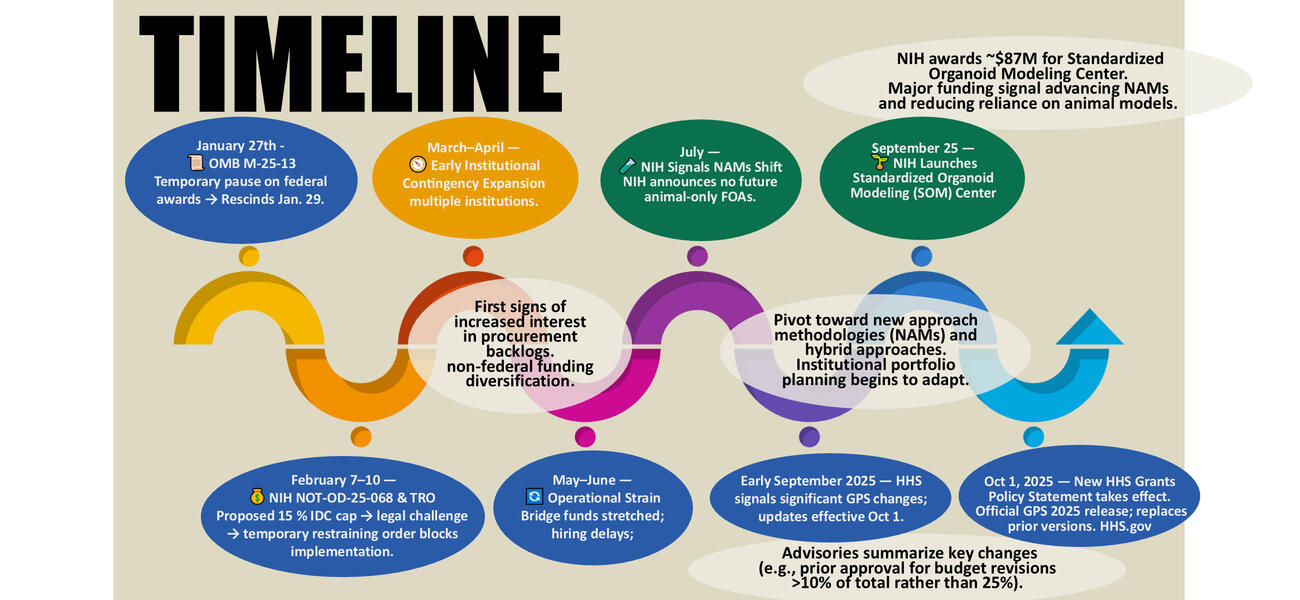
The federal Office of Management and Budget directed a temporary pause on awards in January 2025 only to rescind it days later. The whiplash exposed the systemic fragility of cashflow and the ability to make timely funding withdrawals.
Strategies for Resilient Operations
Courtesy of Sally Thompson-Iritani
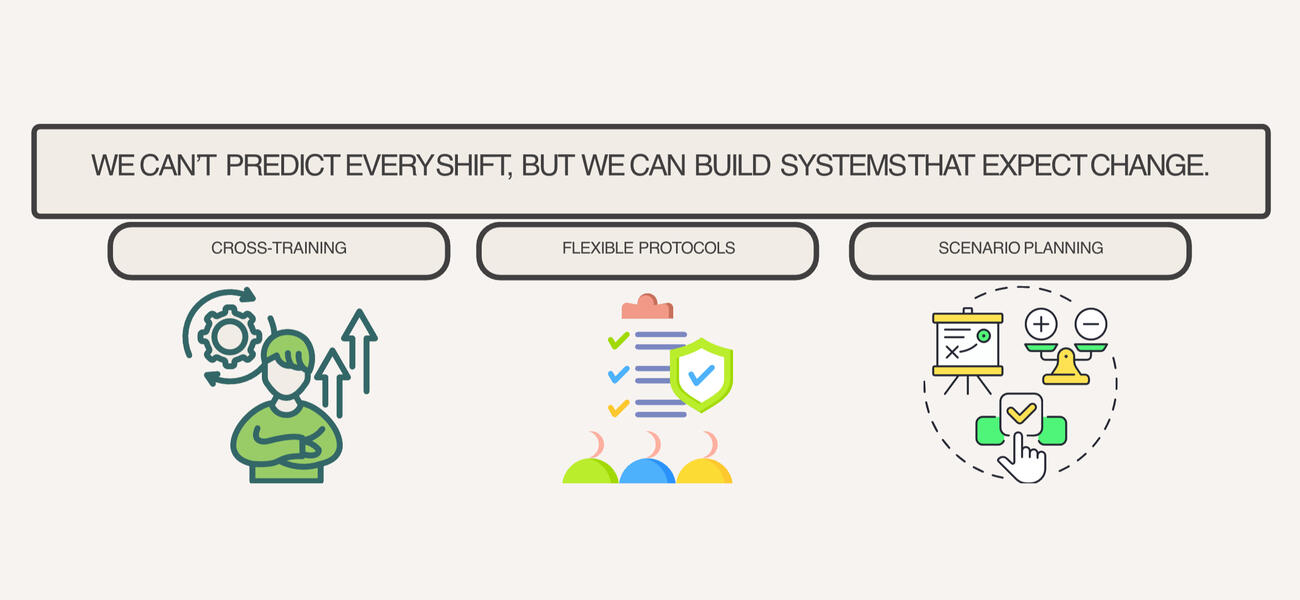
Cross-training animal care staff, implementing flexible protocols, and developing ongoing scenario planning can safeguard research institutions against unreliable funding and policies.
The concept of resilience in animal research facilities goes well beyond regulatory compliance. For those tasked with the care of animals used in critical research, resilience is an ethical commitment rather than a procedural exercise, and it serves as the focus of organizational sustainability. Central to this framework is a concept called a “culture of care,” built on four pillars: scientific integrity, animal welfare, human welfare, and openness in communication. These pillars are intended to serve as the foundational basis for every operational decision, particularly as the research environment grows more volatile.
“Resilience isn’t just about these regulatory check boxes,” says Sally Thompson-Iritani, assistant vice provost, Animal Care Outreach, at the University of Washington. “It’s an ethical anchor. No matter what hits us, our teams need to maintain care for our animals; they need to maintain our research integrity.”
People First: Personnel Resilience
Before vivarium systems can be made resilient, the people within them must be. Stress, reframed as a tool rather than an enemy, is central to this idea. Too little stress leads to stagnation—sometimes called “rust out”—while too much produces burnout. The goal is maintaining an optimal zone of stress that keeps personnel responsive and adaptive.
Cross-training, flexibility, scenario planning, and operational buffers are essential to building that responsiveness. These “shock absorbers” help staff remain capable under pressure and allow team members to step in for one another when circumstances demand it. The design principles guiding this approach emphasize clarity (everyone knows who does what), compassion (processes support both people and animals, not just rules), and courage (the willingness to make difficult decisions).
The same logic that applies to people applies to physical and operational systems. The concept of “controlled stretch”—maintaining flexibility at all times without breaking—should be embedded into how vivaria are organized, staffed, and funded.
Contingency Planning and Physical Flexibility
Most facilities with species regulated by the U.S. Department of Agriculture (USDA) already maintain disaster contingency plans covering floods, fires, and other natural events. These plans address cross-training, communication protocols, decision-making hierarchies, and psychological support for staff during crises. As Thompson-Iritani observes, “Our vivaria, we know, are living systems that must flex and be flexible like an organism.” Elasticity in space allocation is critical to avoiding bottlenecks during any type of disruption.
For those designing or renovating facilities, modularity is the defining principle for the future. Transformable, reconfigurable spaces that can shift function as program needs evolve are the goal. COVID-era supply chain failures also underscored the need for redundancy in suppliers and vendor diversity—lessons that should be formalized into every facility’s operational plan.
Critically, contingency systems must be tested. A system that has never been exercised is a system that will fail when it is needed most. Regular drills and scenario exercises maintain the “optimal stress” that keeps both personnel and systems ready to respond.
The Federal Funding Disruptions of 2025
Despite years of contingency planning, a series of policy actions beginning in January 2025 exposed a significant gap: Existing plans were designed for natural disasters, not financial ones.
On January 27, 2025, the Office of Management and Budget issued an order pausing all federal awards administered through the Department of Health and Human Services. For vivaria leaders, the implications were immediate and alarming. As Thompson-Iritani describes the moment: “I’m just thinking about the animals, the animal care, and the science. How am I possibly going to do this without any federal funds coming in? I can’t. I’ll be honest with you; I don’t know how to. This is this federal funding cliff. When they told us you’re not going to have money coming in, everybody said, “We have no backup system. We have nothing that can support these programs.”
The freeze lasted only 48 hours before an uproar led to its reversal, though some organizations experienced longer interruptions. Even so, as Thompson-Iritani notes, “Even for 48 hours, this federal funding cliff really shocked our system, and made us realize that we are not ready for this funding source to not be available to us. We discovered the vulnerability of incredibly fragile finances. And this vulnerability is so significant as we are trying to move forward, because everybody realizes we cannot rely on this source of funding anymore. We are so fragile, and our contingency plans which are so spectacular and we have been exercising and utilizing for years, are not set up to support us when we do not have money flowing in to support our systems. Vivaria are not designed for this.”
Less than two weeks later, a second disruption arrived: a proposed 15% cap on Indirect Cost (IDC) recovery rates. IDCs, sometimes called “facilities and administrative” costs, are the negotiated rates institutions receive to cover overhead expenses associated with federally funded research. For many institutions, the proposed cap would represent a 20% to 65% cut in revenue. “I will tell you what I told my researchers,” says Thompson-Iritani. “You are going to do no research when I cannot even keep the lights on.” A temporary restraining order has paused implementation of the IDC cap, but the underlying policy pressure has not been resolved, and some reduction in IDC rates is widely anticipated.
Stop-work orders added another layer of uncertainty. Researchers began receiving mid-study notifications that grants had been discontinued, with no reliable mechanism to forecast which awards would be affected next. Bridge funding, while available in limited amounts at some institutions, is not a sustainable response at scale.
Responding to Financial Disruption
The disruptions made clear that vivarium leaders need to treat financial shocks with the same structured preparedness they apply to physical emergencies. “Things are changing,” acknowledges Thompson-Iritani. “This isn’t going to stop. We’re going to have to figure out how to do things differently.”
Two broad levers are available: increasing revenue and decreasing costs. On the revenue side, diversification of funding sources is the most viable path, though it comes with complications. Donor development, for instance, is constrained by the reality that many institutional donors are reluctant to fund research involving animals—a communication and perception challenge that facilities must actively address.
Adaptive budgeting has emerged as a key operational tool. Rather than static annual budgets, adaptive budgeting means continuously monitoring expenditures and revenues through financial dashboards and adjusting in real time. The goal is to identify vulnerabilities before they become crises. Which grants are most exposed to policy shifts, which programs could be sustained with bridge funding, and which would require reduction or discontinuation?
Scenario planning—running through contingencies A through Z—is essential. Which animals could be relocated? What would happen to ongoing studies if a specific funding source were cut? Facilities that have mapped these scenarios in advance are far better positioned to respond with intention rather than panic when disruptions occur.
The Shift Toward New Approach Methodologies
Alongside funding pressures, a significant policy shift is underway in how federal agencies prioritize research methodologies. Resources within the Department of Health and Human Services are being actively redirected toward New Approach Methodologies (NAMs), meaning this is a reallocation, not a supplemental investment.
NAMs adoption, however, can also be viewed as a resilience lever. Investing in staff development in these new methodologies expands organizational capability and keeps personnel in that productive zone of challenge and growth. Facilities that build capacity across both traditional animal care and NAMs-related techniques diversify their workforce skillsets and position themselves for a changing research landscape.
A further policy change affects how researchers manage the funds they do receive. Previously, principal investigators could reallocate up to 25% of a grant’s budget between categories without prior National Institutes of Health (NIH) approval. That threshold has been lowered to 10%. Any reallocation beyond that amount now requires NIH authorization. This change substantially increases the administrative burden on researchers and the support staff who manage compliance—a significant operational consideration for facilities working to do more with less.
Communication, Leadership, and Shared Accountability
The human dimension of these disruptions cannot be underestimated. Staff burnout is a genuine risk when policy notices arrive on Friday afternoons and require weekend responses. Leaders must remain visible, transparent, and steady—modeling urgency balanced with empathy. Transparent communication builds the trust that teams require to remain functional under pressure, and it must be consistent, with one reliable source of timely information that aligns with core organizational values.
External communication is equally important. The consequences of federal funding interruptions—including the potential need to euthanize animals if care cannot be sustained—are not abstract. Articulating those stakes clearly and publicly, as difficult as it may be, serves both the advocacy mission and the trust of research communities, policymakers, and the public.
“Scenario planning is so critical,” stresses Thompson-Iritani.
No organization weathers financial disruption alone. Partnerships, peer networks, and shared learning across institutions are essential assets. Every lesson learned in real time should be embedded into updated protocols, without blame, and with a commitment to continuous improvement.
Automation and artificial intelligence offer practical tools for extending staff capacity without replacing it. Routine monitoring, data tracking, and administrative tasks are strong candidates for technology support, freeing skilled personnel to focus on animal care, critical thinking, and research support. As Thompson-Iritani explains, “AI is not going to replace people. People who use AI are going to replace us, so let’s embrace it.” The strategic integration of technology into vivaria operations is not a distant aspiration—it is a near-term competitive and operational advantage.
Three Principles for Moving Forward
Resilience, in the end, is not a reactive posture—it is a deliberate strategy. Three principles distill the operational priorities for vivarium leaders navigating this period:
- Design for stretch, not snap. Build systems—both human and physical—that can absorb stress and flex without breaking. Modularity, cross-training, and scenario planning are the practical expressions of this principle.
- Integrate NAMs and diversify funding. A facility that expands its methodological toolkit and broadens its revenue base is better insulated from any single policy shift or funding interruption. These are not concessions to external pressure; they are investments in long-term stability.
- Strengthen communication at every level. Internal transparency builds team cohesion. External communication builds advocacy capacity. And the relationships formed through peer networks and institutional partnerships are what make it possible to move through uncertainty without moving through it alone.
The research environment will keep changing. The facilities and leaders that remain viable will be those that treat resilience as a standing practice—not a contingency for rare emergencies, but a daily operating principle embedded in culture, process, and design.
***
For the latest strategies on building resilience into your animal facility operation, plan to attend the Tradeline Animal Research Facilities 2026 conference. Join us in Boston in August!